
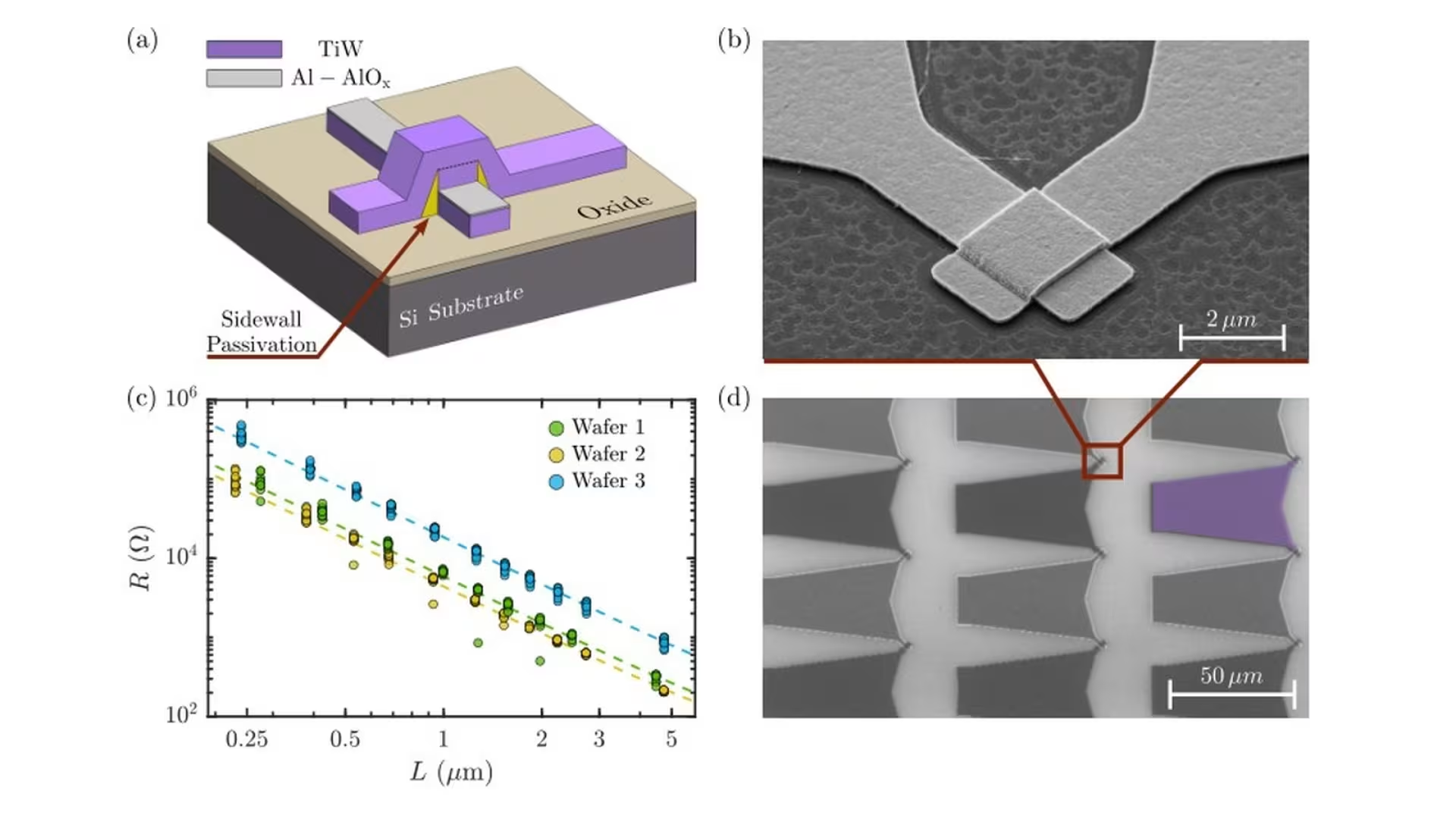
Aluminium tunnel junctions with aluminium oxide barriers have dominated cryogenic electronics for decades, but aluminium becomes superconducting below 1.2 K, which many applications do not want. Researchers at VTT Technical Research Centre of Finland and partners have developed a CMOS-compatible alternative that stays non-superconducting, using titanium–tungsten (TiW) alloy electrodes with AlOx barriers.
The team fabricated TiW/Al-AlOx/TiW junctions at wafer scale and validated them in Coulomb blockade thermometers operating down to 20 mK, confirming robust normal-state behaviour. The technology offers a scalable route to non-superconducting junctions in cryogenic, quantum and nanoelectronic chips. The VTT team, including Juho Luomahaara, Janne Lehtinen and Mika Prunnila, worked with the University of Basel and Lancaster University.
The preprint has not yet been peer reviewed.
Figure: Luomahaara et al., arXiv:2602.14637 (2026), CC BY 4.0