
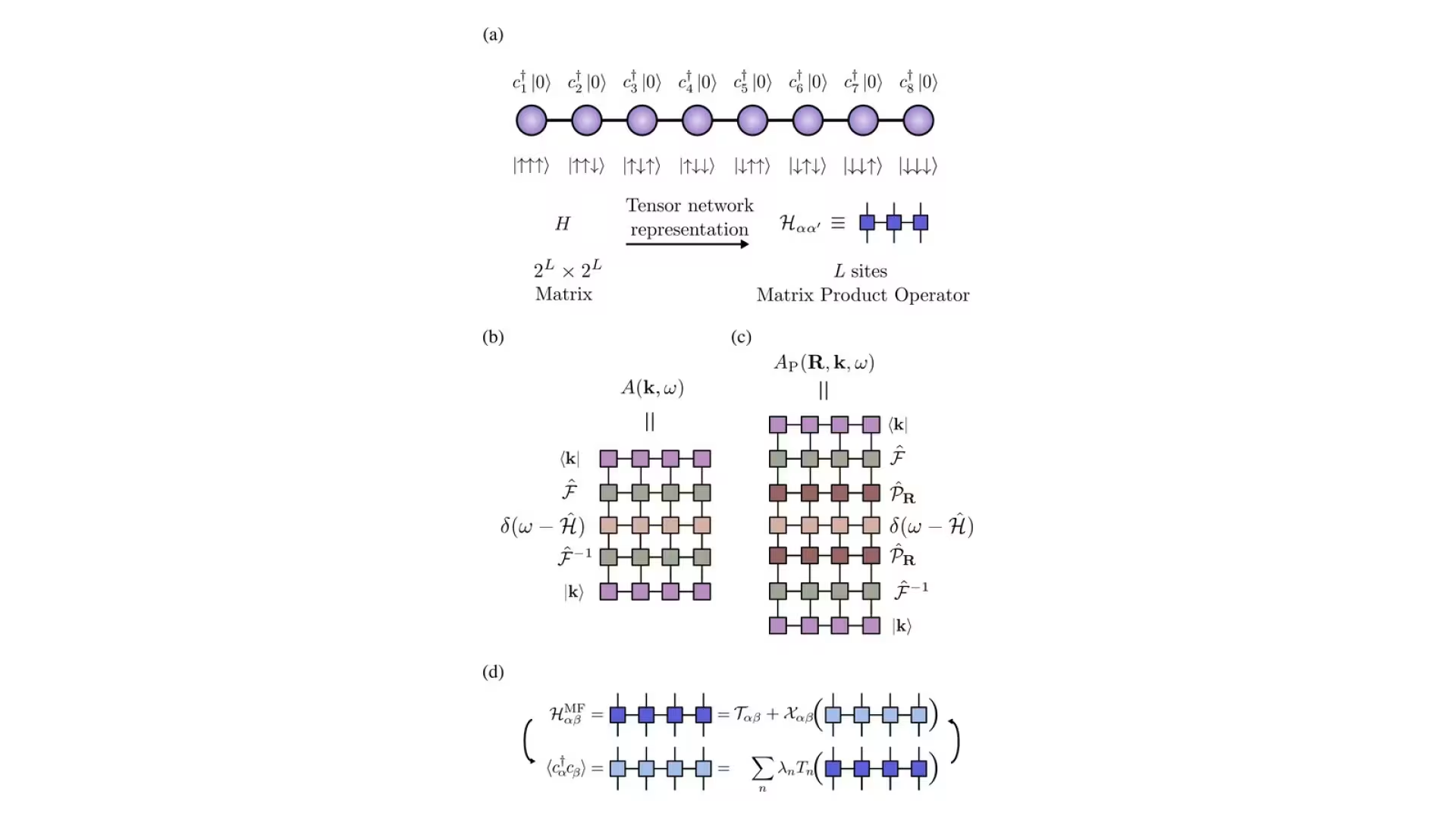
Super-moiré materials, made by stacking and twisting several atomically thin layers, form patterns so large and irregular that standard calculations cannot handle them. QMAT researchers at Aalto University have now developed a tensor-network method that computes momentum-resolved spectral functions of such systems at the atomistic level.
The approach recasts an exponentially large tight-binding problem as an auxiliary quantum many-body problem and solves it with tensor-network algorithms, including a tensor-network quantum Fourier transform. It works for strained, interacting and quasicrystalline super-moirés, and can show how the electronic structure changes from one region of a sample to another, giving a direct way to model quantum twisting microscope experiments. The authors are Anouar Moustaj, Yitao Sun, Tiago Antão and Jose Lado of QMAT's Correlated Quantum Materials group.
Figure: Moustaj et al., Phys. Rev. Research (2026); image from arXiv:2512.18397, CC BY 4.0