
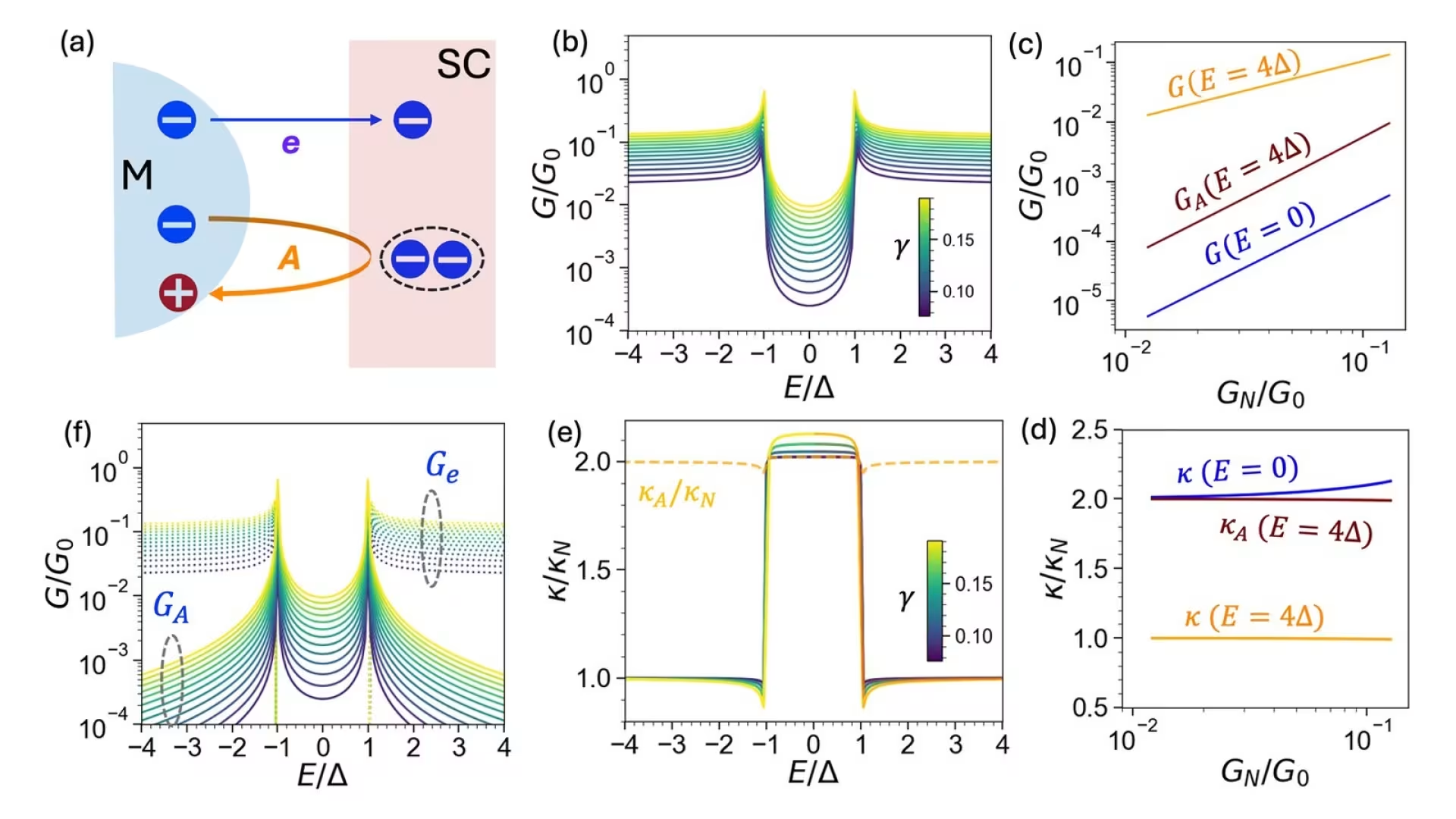
Tunnelling Andreev reflection spectroscopy is a new way to identify the pairing symmetry of a superconductor at the atomic scale, using how quickly the tunnelling current decays as the tip moves away. Atomistic superconducting transport simulations now show that the method can cleanly separate Andreev reflection from ordinary quasiparticle tunnelling.
Andreev reflection dominates the mid-gap signal in s-wave superconductors, is suppressed in d-wave ones, and coexists with quasiparticle tunnelling for other sign-changing symmetries. These distinct fingerprints could help identify unconventional superconducting states atom by atom. QMAT's Jose Lado of Aalto University's Correlated Quantum Materials group co-authored the work with researchers at Oak Ridge National Laboratory, Clemson University and the University of Tennessee, Knoxville.
Figure: Maksymovych et al., Small (2026); image from arXiv:2601.20798, CC BY 4.0