
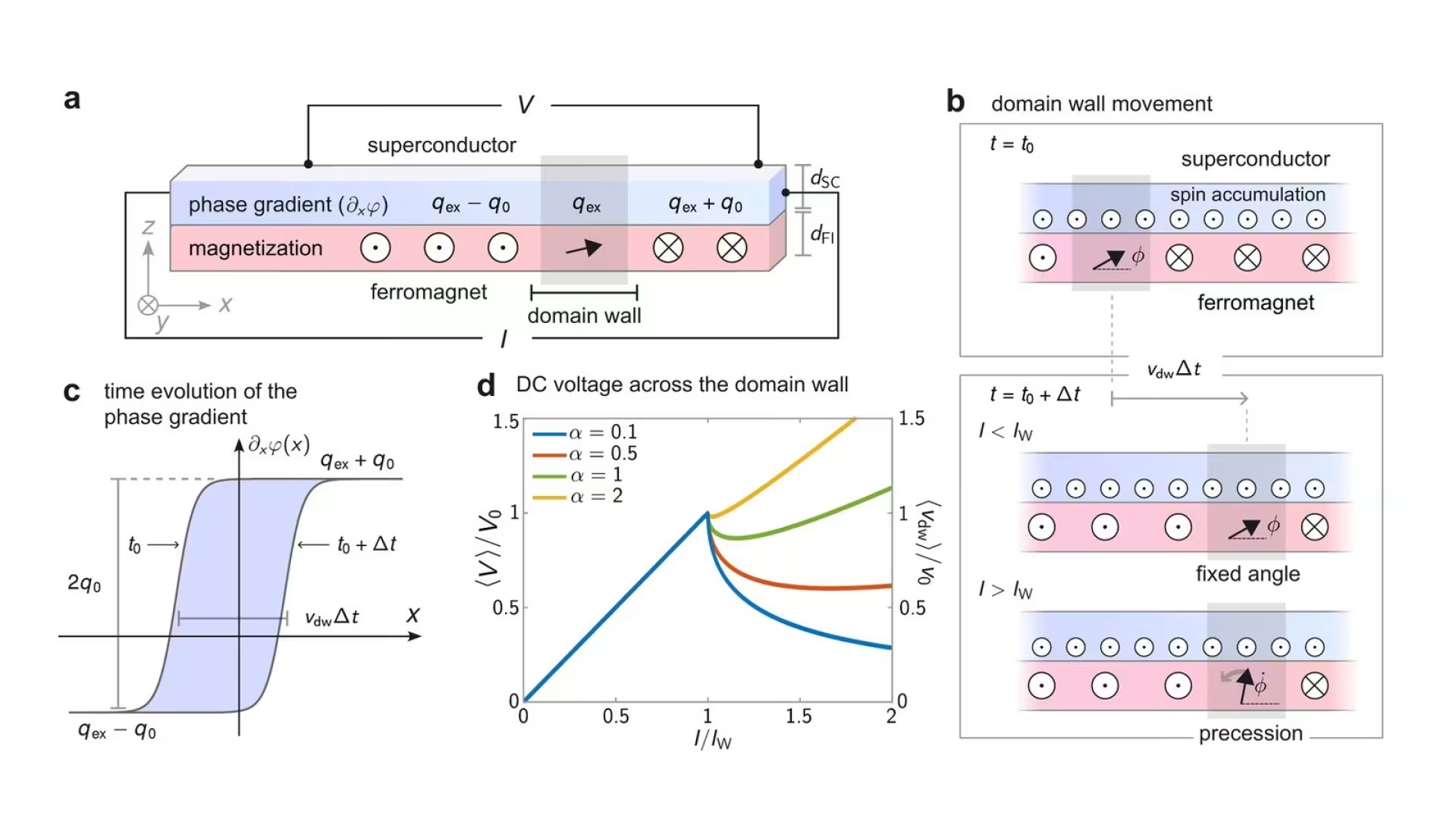
Cryogenic computing needs fast, reliable and energy-efficient magnetic memory, which room-temperature technologies cannot provide. Theorists show that in a bilayer of a superconductor and a magnetic insulator, a supercurrent generates spin accumulation that, together with magnetic (Gilbert) damping, sets magnetic domain walls in motion.
The motion produces a local voltage across the wall, which makes it possible to locate it. The power needed to keep the wall moving is orders of magnitude smaller than with currents in the normal state, where most of the energy is wasted in producing the current. The paper is by Tim Kokkeler, Risto Ojajärvi and Tero Heikkilä of QMAT's Condensed Matter Theory group at the University of Jyväskylä, with Sebastian Bergeret of CFM and DIPC in San Sebastián.
Figure: Kokkeler et al., Phys. Rev. B (2026); image from arXiv:2606.19078, CC BY 4.0