
Quantum materials this week: spin-resolved evidence for p-wave magnetism, thin FeSe that switches its pairing symmetry, and supersolid exciton crystals
Magnetism with an unusual symmetry leads this week. Nature reports photoemission evidence for p-wave magnetism in the simple metal EuSi, Nature Communications finds that exfoliating the iron-based superconductor FeSe weakens its nematic order and switches its superconducting gap from s-wave to d-wave-dominant, and Nature Physics demonstrates crystalline supersolids of dipolar excitons in a lattice. Preprints below await peer review unless a journal link is given.
Journal highlights
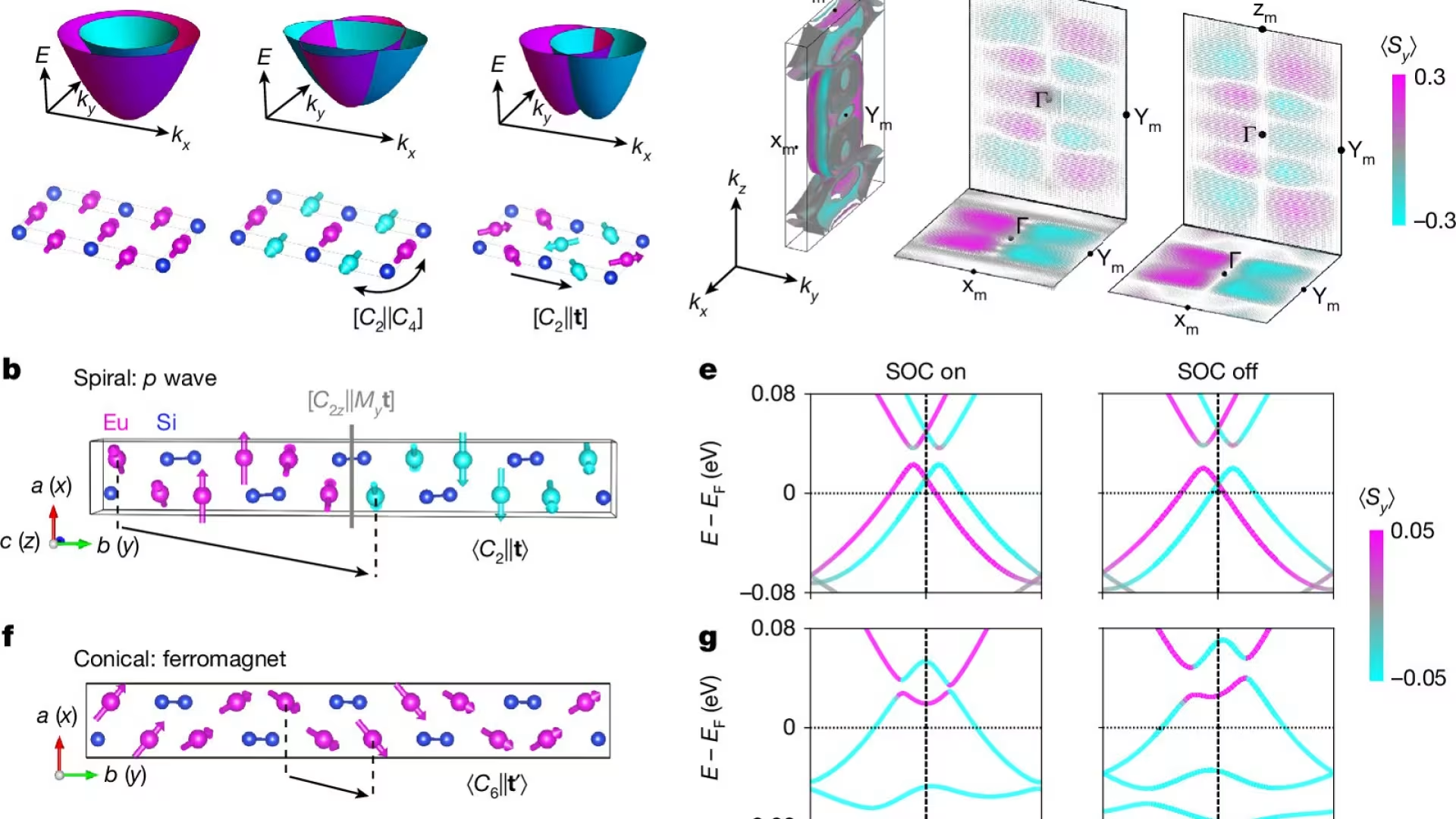
Evidence for p-wave magnetism in the band structure of metallic EuSi
Erjian Cheng, Yixing Yang, Yifan Gao, Jan Priessnitz and colleagues, in a large team including Libor Šmejkal, Oliver Rader and Yulin Chen, studied stoichiometric EuSi with angle-resolved and spin-resolved photoemission, backed by symmetry analysis, first-principles calculations and neutron scattering. P-wave magnets are the magnetic analogue of p-wave superconductors: a spin-polarised Fermi surface with p-wave symmetry that nevertheless respects time reversal combined with a lattice translation. Neutron diffraction shows a chiral spiral phase between 33.4 K and 62 K that meets these criteria while breaking inversion symmetry. Photoemission reveals a magnetism-driven reconstruction of the bands with energy separations above 100 meV, and spin-ARPES resolves an in-plane spin polarisation that changes sign across successive magnetic Brillouin zones and is suppressed near the nodes, as predicted for a p-wave spin texture. Magnetic force microscopy also shows chiral magnetic domains of about 10 µm. Caveat: the spin texture is inferred from a single polarisation component compared with calculations; the value of the work is a clean, stoichiometric metal in which p-wave magnetism can be probed directly in the electronic structure.
Primary source: Cheng et al., Nature (open access, published 18 Nov 2026; in the 26 Nov issue).
Exfoliation switches the superconducting symmetry of FeSe
Wenyao Liu, Gabriel Natale and colleagues, led by Kenneth S. Burch with co-authors including Takasada Shibauchi, Judy J. Cha and Maia G. Vergniory, show that simply thinning FeSe tunes the balance between its intertwined orders. Transport, electron microscopy and Raman spectroscopy show that the bulk electronic nematic order is substantially weakened in thin flakes. Angle-dependent Andreev reflection spectroscopy on pristine crystal edges then shows spectra that change from zero-energy bound states to coherence peaks as the junction orientation is rotated; with modelling, the authors conclude that the pairing changes from bulk s-wave to d-wave-dominant. Caveat: the symmetry assignment relies on interpreting edge Andreev spectra through a model; the attraction is a chemistry-free, strain-free knob on competing orders in a 2D superconductor.
Primary source: Liu et al., Nature Communications (open access, published 20 Nov 2026).
Supersolid crystals of dipolar excitons in a lattice
C. Morin, C. Lagoin and colleagues, with G. Pupillo and F. Dubin, confine dipolar excitons in a lattice with long-range hopping to realise supersolids in the strongly interacting regime, where previous evidence has been limited to weakly interacting, fragmented superfluids. At fractional fillings of one-quarter, one-third and one-half, they observe mesoscopic quantum crystals across about 100 sites that spontaneously break the lattice translational symmetry, while coherent long-range hopping produces off-diagonal long-range order, so the exciton solids are also superfluid. Numerical calculations support supersolidity in the ground state of the lattice model. Caveat: the crystals are mesoscopic, and the platform is a semiconductor exciton system rather than an electronic quantum material; it is included as a solid-state route to strongly correlated bosonic phases.
Primary source: Morin et al., Nature Physics (published 25 Nov 2026).
Preprints worth watching
Local Kitaev spin-liquid signatures in α-RuCl3 nanoflakes from NV spin-noise spectroscopy
Jitender Kumar, Sehrish Iqbal and colleagues, with Amit Finkler and Abdelghani Laraoui, place diamond nitrogen-vacancy centres next to α-RuCl3 flakes 8 to 150 nm thick and measure the NV spin-relaxation time between 4.3 and 250 K. Relaxation speeds up markedly below about 100 K near the flakes, indicating enhanced GHz magnetic fluctuations on a temperature scale consistent with the Kitaev interaction and the emergence of fractionalised excitations. Below 50 K, thicker flakes show a bi-exponential decay, suggesting an increasingly heterogeneous magnetic noise environment. Caveat: preprint; the noise signal is consistent with, but not unique to, a spin-liquid regime, and the authors present it mainly as a new local probe.
Primary source: arXiv:2611.33085 (submitted 24 Nov 2026).
Band-selective coupling to charge-density-wave fluctuations in kagome superconductors
Peter C. Moen and colleagues use time- and angle-resolved photoemission on CsV3Sb5 and KV3Sb5 and observe coherent band oscillations driven by a low-energy charge-density-wave amplitude mode at 3.1 THz. The coupling is strongly band-selective, differing by more than a factor of two even between bands of dominant V-3d character, and differs between the two compounds; frozen-phonon calculations reproduce the trend. Caveat: preprint; the link to superconducting pairing is argued rather than measured directly.
Primary source: arXiv:2611.31362 (submitted 23 Nov 2026).
Electronic structure of the ambient-pressure nickelate candidate Sr3Ni2O5Cl2
Ryota Goban, Daiki Ootsuki and colleagues, with Takayoshi Yokoya, report photoemission on Sr3Ni2O5Cl2, a candidate ambient-pressure bilayer nickelate superconductor. The valence band is best reproduced by DFT+U with U = 3 eV, giving an experimental estimate of electron correlation, and spectra near the Fermi level show a marked temperature dependence that phonon broadening alone does not explain. Caveat: preprint; it provides baseline electronic-structure data rather than evidence on superconductivity itself.
Primary source: arXiv:2611.30088 (submitted 23 Nov 2026).
Also noted
Researchers at the Beijing Academy of Quantum Information Sciences report a metastable 1T′ phase in bilayer NbSe2 films, made by selenium intercalation followed by ultra-high-vacuum annealing, a possible route to sliding ferroelectricity combined with superconductivity (published in Nanoscale on 18 Nov): Xinhua report, in Chinese (23 Nov 2026).
QST and partners report a fabrication method for nanodiamond quantum sensors that cuts particle-to-particle variation to about one-quarter and raises the quantum signal by 55% (published in ACS Nanoscience Au): Science Japan (24 Nov 2026).
SUSTech publicised a symmetry-guided framework, based on oriented spin space groups, that predicts magnetic ground states from the crystal structure alone (Physical Review X, featured in APS Physics): SUSTech news (24 Nov 2026).
Preprints in this roundup should be read as provisional until the final peer-reviewed versions appear.