
Quantum materials this week: graphene that dopes itself in whole electrons, a layered recipe for trilayer-cuprate superconductivity, and nickelates under strain
Interfaces and layers set the tone this week. Nature reports a graphene heterostructure whose stacking and doping switch together between discrete states, Nature Communications finds that the trilayer cuprate Bi-2223 combines an underdoped, charge-ordered inner plane with overdoped outer planes in a way that boosts both pairing and coherence, and npj Quantum Materials maps how epitaxial strain retunes magnetism in superconducting La3Ni2O7 films. Preprints below await peer review unless a journal link is given.
Journal highlights
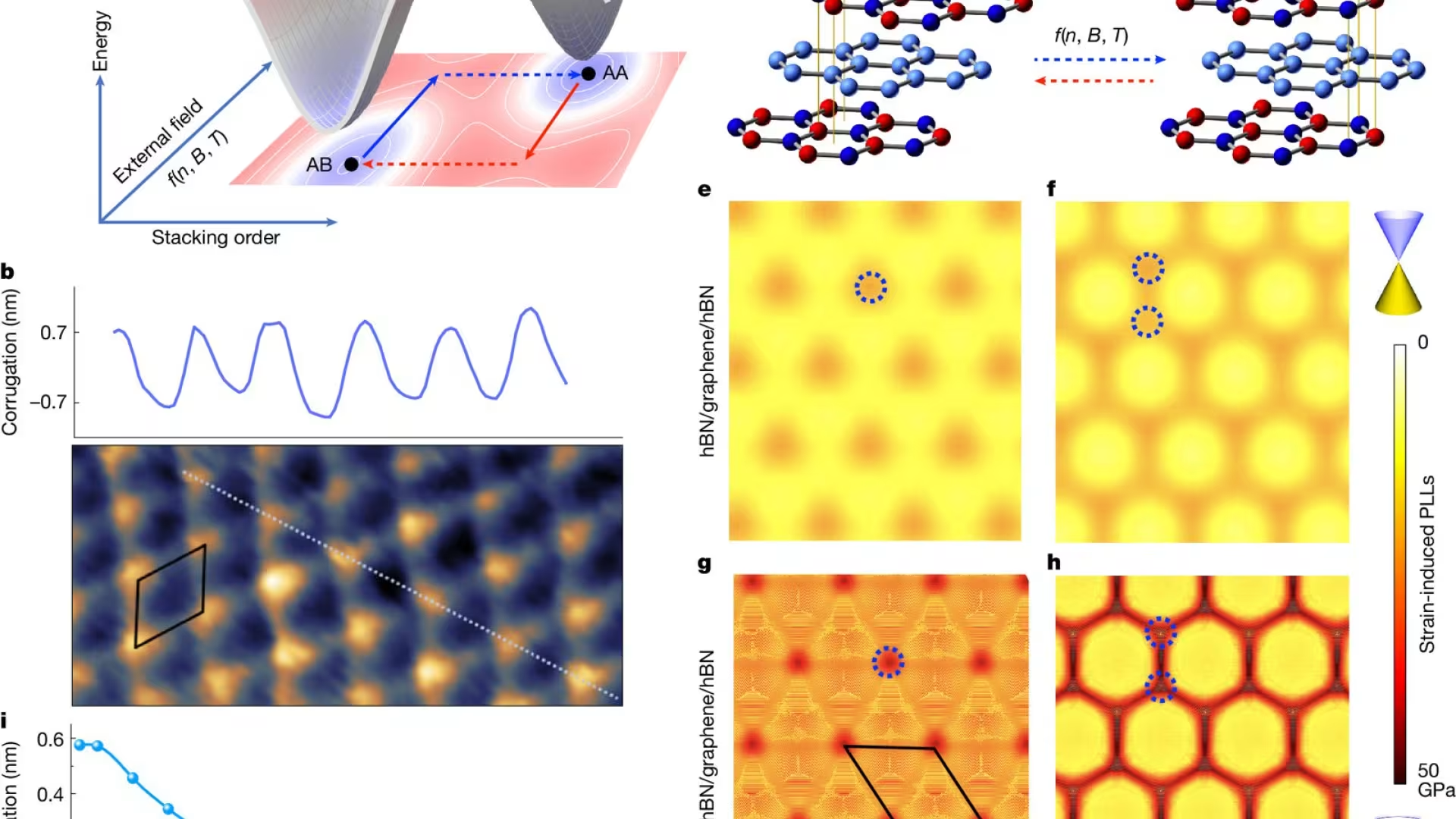
Flat-band-induced integer doping and a switchable structural phase in monolayer graphene
Z. Wang, C. Moulsdale and colleagues, in a team including A. K. Geim, V. I. Fal’ko, A. H. MacDonald, M. I. Katsnelson and K. S. Novoselov, built a heterostructure in which monolayer graphene is aligned both to bulk hexagonal boron nitride on one side and to a single hBN layer on the other. Scanning tunnelling microscopy shows a global structural phase transition, seen as a change in crystal symmetry, that can be triggered by gating, magnetic field or temperature. The transition is accompanied by an unusual electronic one: the graphene’s doping jumps between discrete levels corresponding to an exact integer number of electrons or holes per moiré cell. The authors attribute this to charge trapped in localised, strain-induced pseudo-Landau levels, flat bands produced by moiré reconstruction and strongly enhanced by the monolayer hBN. Caveat: the interpretation rests on the pseudo-Landau-level picture; the broader point is electrical control of coupled structural and electronic transitions in van der Waals stacks, which are usually treated as rigid.
Primary source: Wang et al., Nature (open access, published 18 Nov 2026).
Different planes, different jobs in the trilayer cuprate Bi-2223
Steef Smit, Martin Bluschke and colleagues in Andrea Damascelli’s group at UBC, with collaborators including Bernhard Keimer and Massimo Capone, used time- and angle-resolved photoemission on Bi2Sr2Ca2Cu3O10+δ. Trilayer cuprates hold the record for superconducting critical temperatures, but why has remained unclear. They find charge order on the inner CuO2 plane, confirmed with resonant X-ray scattering, and a large superconducting gap that marks this plane as underdoped. Even so, the inner plane shows unusually coherent quasiparticles, and suppressing charge-order fluctuations raises that coherence further. The overdoped outer planes, meanwhile, carry larger gaps than similarly doped single- and bilayer cuprates. Supported by Hubbard-model calculations, the authors propose an interlayer mechanism in which pairing strength and phase coherence are both optimised by stacking planes with different hole concentrations. Caveat: the model calculations support rather than prove the mechanism, but the result gives a concrete, testable picture of why three layers beat one or two.
Primary source: Smit et al., Nature Communications (open access, published 17 Nov 2026).
Strain tunes interlayer magnetism in superconducting La3Ni2O7 films
Hengyang Zhong, Bo Hao and colleagues, led by Xingye Lu with Thorsten Schmitt and co-workers, used resonant inelastic X-ray scattering on La3Ni2O7 films with epitaxial strain from about −2% to +1.9%. Compressively strained films on SrLaAlO4, which superconduct above 40 K at ambient pressure, show well-defined spin excitations similar to bulk but with a slightly larger bandwidth. Tensile-strained films on SrTiO3 show a marked loss of magnetic spectral weight and suppressed dz2-related excitations. In a minimal bilayer model, the interlayer exchange grows under compression and shrinks substantially under tension. Caveat: the dd features are also sensitive to oxygen content and are treated only qualitatively; the value of the work is as a spectroscopic constraint on theories that put interlayer magnetic exchange at the heart of nickelate superconductivity.
Primary source: Zhong et al., npj Quantum Materials (open access, published 14 Nov 2026).
Preprints worth watching
Bosonic quantum phases in a moiré flat-band superconductor
Yu Hong, Haiming Sun and colleagues, with Guangyu Zhang and Wei Yang, study alternating twisted trilayer graphene, where superconductivity peaks near half-filling of the moiré flat band. They see separate temperature scales for pairing (about 6 K) and condensation (about 1 K), and a field-driven superconductor–insulator transition with a universal critical resistance of about 0.62 times the boson resistance quantum h/4e2, which the authors read as quantum phase fluctuations of already-formed pairs controlling superconductivity. Caveat: preprint; the bosonic interpretation relies on scaling analysis, which should be tested in more devices.
Primary source: arXiv:2611.17882 (submitted 13 Nov 2026).
Bulk superconductivity in square-planar La5Ni4O10 crystals at ambient pressure
R. Zhang, P. Reiss and colleagues at the Max Planck Institute for Solid State Research grew bulk single crystals of the four-layer Ruddlesden–Popper nickelate La5Ni4O13 under high pressure and temperature, then reduced them with CaH2 to square-planar La5Ni4O10. The result superconducts at ambient pressure with an onset near 18 K, a shielding fraction above 60% and a specific-heat jump that indicates bulk pairing; the upper critical field is only weakly anisotropic, suggesting three-dimensional superconductivity. Until now, these layered square-planar phases had been studied mainly as thin films. Caveat: preprint; superconductivity coexists with a density-wave or metal–insulator transition, so sample homogeneity will matter.
Primary source: arXiv:2611.12788 (submitted 9 Nov 2026).
Measuring the quantum geometry of magnons with neutrons
S. Kim, M. Stone, S. E. Nagler and colleagues, with H. Miao, show that the inelastic neutron-scattering cross-section of a ferromagnet encodes geometric parameters of the magnon wavefunctions, so the quantum geometric tensor can be extracted from energy- and momentum-dependent intensities without a detailed spin model. Quantum geometry underlies effects from the quantum Hall effect to flat-band superconductivity but is notoriously hard to measure directly. Caveat: preprint; the framework is demonstrated for ferromagnets, and extensions to more complex magnets remain to be shown.
Primary source: arXiv:2611.18897 (submitted 13 Nov 2026).
Also noted
Twisted freestanding SrTiO3 bilayers reconstruct into a network of screw dislocations that hosts polar vortex–antivortex pairs, offering an oxide route to twist-designed polar and electronic textures: Sandholt et al., Nature (18 Nov 2026).
A Nature Physics News & Views on a photonic crystal that mimics altermagnetic symmetry, with circular polarisation standing in for spin: Yang, Nature Physics (11 Nov 2026).
The National Laboratory of the Rockies publicised its unified picture of how localised and delocalised excitons coexist in 2D magnetic semiconductors such as CrSBr: NLR press release (16 Nov 2026).
UCLA and Auburn publicised surface-acoustic-wave measurements showing strong spin–lattice coupling across the antiferromagnetic transition in thin NiPS3 (paper published in October): Ebrahim Nataj et al., Nature Communications (2026); press release via Phys.org (16 Nov 2026).
Preprints in this roundup should be read as provisional until the final peer-reviewed versions appear.