
Quantum materials this week: strain as a new knob for magic-angle graphene, layer-resolved phonons in a cuprate, and pressure-made superconductivity in a topological insulator
Mechanical tuning dominates this week. Science reports that uniaxial strain changes the resistance of magic-angle twisted bilayer graphene more than a hundred times as strongly as in an ordinary metal, Nature Communications resolves which phonons live in which atomic layers of the cuprate Bi2Sr2CaCu2O8+δ, and Physical Review Letters reports superconductivity in Bi2Se3 under hydrostatic pressure without losing its topological crystal structure. Preprints below await peer review unless a journal link is given.
Journal highlights
Giant elastoresistance in magic-angle twisted bilayer graphene
Xuetao Ma, Zhaoyu Liu and colleagues in Matthew Yankowitz and Jiun-Haw Chu’s groups at the University of Washington mounted twisted bilayer graphene devices on a piezoelectric stage to apply continuous uniaxial strain while measuring transport. Near the magic angle (≈1.1°), the resistance responds to strain with a gauge factor more than two orders of magnitude larger than that of conventional metals, and far larger than in Bernal-stacked bilayer graphene. The effect depends on band filling and temperature, and in selected doping regimes it shows a Curie–Weiss-like divergence on cooling. The authors discuss nematic fluctuations and the large electronic entropy of fluctuating isospin moments as possible origins. Caveat: the microscopic mechanism is not yet pinned down; the main result is that strain joins twist angle and pressure as a practical tuning knob and probe of correlated moiré physics.
Primary source: Ma et al., Science 394, 768–772 (12 Nov 2026); press release via University of Washington on Phys.org (12 Nov 2026).
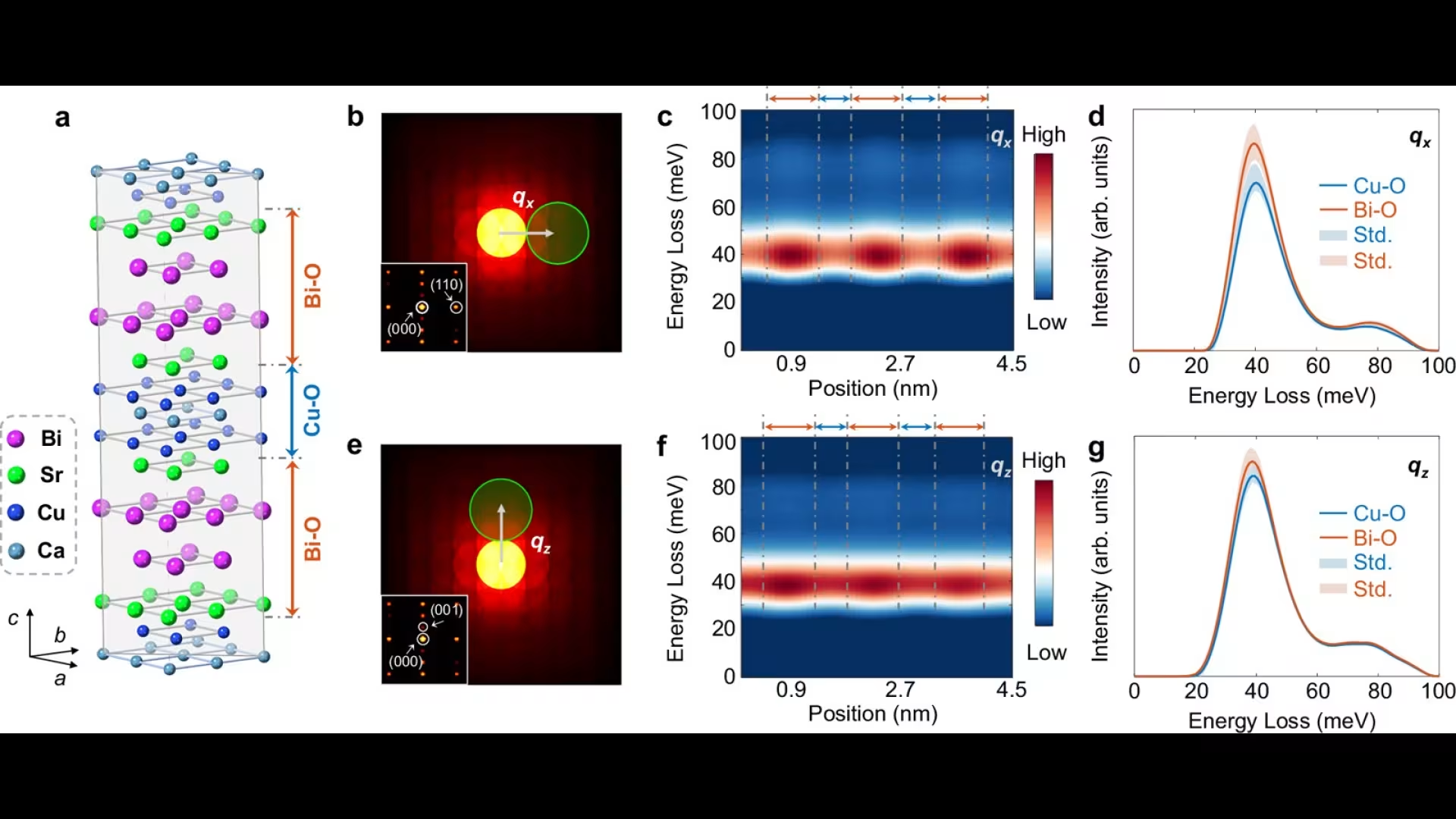
Layer-resolved phonons in the cuprate superconductor Bi-2212
Using sub-unit-cell-resolved electron energy-loss spectroscopy in a scanning transmission electron microscope, Xiaowen Zhang, Peng Gao and co-workers separate phonon modes belonging to the charge-reservoir and superconducting layers of Bi2Sr2CaCu2O8+δ. They find ~78 meV in-plane modes localised in the CuO2 planes, ~42 meV hybrid modes in the CuO2 planes and ~38 meV hybrid modes in the BiO layers. The structural superlattice periodically modulates phonon frequencies, and that modulation correlates spatially with known variations of the superconducting gap. Caveat: a spatial correlation does not by itself establish that phonons drive or strongly shape pairing in cuprates, but the technique gives a direct, layer-specific handle on that long-standing question.
Primary source: Zhang et al., Nature Communications (open access, published 6 Nov 2026).
Superconductivity in topological Bi2Se3 under hydrostatic pressure
A team led from the Southern University of Science and Technology (SUSTech) with the Hefei High Magnetic Field Laboratory reports superconductivity in the prototypical topological insulator Bi2Se3 while it keeps its ambient-pressure R-3m structure. Earlier high-pressure studies had found superconductivity only after a transition to a monoclinic phase. Under quasi-hydrostatic conditions, ~56 nm nanoflakes become superconducting at 2.4 GPa (onset about 8.1 K) and bulk crystals at 4.1 GPa (onset about 5.8 K). X-ray diffraction shows the R-3m phase is stable to about 12 GPa, and Hall analysis identifies a high-mobility surface channel consistent with topological surface states. Superconductivity appears as the bulk carrier density approaches about 1020 cm−3, and the authors argue that pressure uniformity is the key control parameter. Caveat: coexistence of superconductivity and nontrivial topology is not yet proof of topological superconductivity or Majorana modes.
Primary source: Zheng et al., “Hydrostatic Pressure-Induced Superconductivity in the Topological Phase of Bi2Se3”, Physical Review Letters (accepted); press release via SUSTech (11 Nov 2026).
Josephson trijunctions on a topological insulator as a Majorana source and path
Kyungtae Kim, June-Young M. Lee, Hyeongseop Kim and H.-S. Sim (KAIST) show theoretically that a trijunction, where three Josephson junctions meet on a topological insulator in a perpendicular magnetic field, can generate, move and annihilate Majorana bound states as the superconducting phases cross topological phase boundaries. Depending on the boundary crossed, the trijunction either creates a pair and ejects one Majorana into a junction, or lets a single Majorana travel between junction and centre. A double-trijunction network could then perform fusion and braiding without dynamical gate control, read out by Josephson emission spectroscopy. Caveat: this is a theoretical proposal and still needs clean topological-insulator Josephson devices to test it.
Primary source: Kim et al., Nature Communications (open access, published 7 Nov 2026).
Preprints worth watching
First quantum Hall Fabry–Pérot interferometer in monolayer WSe2
Himadri Chakraborti, Charles Tschirhart and colleagues, with Jie Shan and Kin Fai Mak, report a gate-defined quantum Hall Fabry–Pérot interferometer in monolayer WSe2, where spin–valley locking gives single-component Landau levels free of the spin and valley degeneracies that complicate graphene interferometers. Tuning the cavity size in one device reveals robust Aharonov–Bohm interference of edge channels, consistent with weak bulk–edge coupling, and temperature and bias dependence give an edge velocity of about 4.9 × 10⁴ m s−1. Caveat: preprint; the integer-regime results lay groundwork, and interferometric tests of anyonic statistics in TMD fractional states are still to come.
Primary source: arXiv:2611.14633 (submitted 10 Nov 2026).
Sign-changing pairing in single-layer FeSe/SrTiO3
Huimin Zhang, Zhuozhi Ge, Michael Weinert and Lian Li use scanning tunnelling spectroscopy on molecular-beam-epitaxy-grown single-layer FeSe/SrTiO3 and find robust in-gap bound states around non-magnetic Fe-vacancy defects. The states show strong electron–hole asymmetry, two-fold symmetry in hole states and four-fold symmetry in electron states, and neither shift nor split in a magnetic field, which the authors read as evidence for a sign-changing order parameter in this long-debated high-Tc interface superconductor. Caveat: preprint; impurity bound states are an indirect probe, and phase-sensitive confirmation would strengthen the case.
Primary source: arXiv:2611.16679 (submitted 12 Nov 2026).
Termination-selective Kondo hybridisation of topological surface states in CeCuAs2
Bo Chen, Jian-Qiao Meng and colleagues combine termination-resolved ARPES, Ce 4d→4f resonant photoemission and surface calculations on the Kondo-lattice compound CeCuAs2. On the CeAs2 termination, a Dirac surface state linked to the calculated nontrivial bulk topology coexists with a weakly dispersive Ce 4f band near the Fermi level, and both gain spectral weight on cooling, giving spectroscopic evidence that the topological surface state acquires 4f character. Caveat: preprint; the topology assignment leans on calculations, and transport signatures of the hybridised surface state are not reported.
Primary source: arXiv:2611.15022 (submitted 11 Nov 2026).
Also noted
A Nature Materials News & Views highlights magnetically tunable exciton–polariton condensation in the van der Waals magnet CrSBr, where a 2 T field shifts the condensate energy by up to 10.5 meV: Deng, Nature Materials (9 Nov 2026), on Zhang et al., Nature Materials (8 Oct 2026).
National Tsing Hua University publicised RIXS evidence for quantum-critical scaling of charge-density-wave correlations in La2−xSrxCuO4, pointing to a quantum critical point buried under the superconducting dome (paper published in June): Huang et al., Nature Communications (2026); press release via NTHU (11 Nov 2026).
Theory of how uniform superconductivity reshapes pair-density-wave order and its quasiparticle topology on the kagome lattice, with AV3Sb5 in mind: arXiv:2611.15354 (11 Nov 2026).
Two distinct Hall anomalies in the kagome magnet TmMn4Cr2Sn6, with a cautionary note on how magnetic transitions can mimic unconventional Hall signals: arXiv:2611.16841 (12 Nov 2026).
Preprints in this roundup should be read as provisional until the final peer-reviewed versions appear.