
Quantum materials this week: altermagnets inject spin currents, show their handedness and survive down to four unit cells, plus a Chern metal in a moiré Kondo lattice
This is an altermagnetism week. Nature reports electrical spin injection from a magnet with no net magnetisation, Science publishes X-ray evidence of the chirality that sets altermagnetic MnTe apart from an ordinary antiferromagnet, and Nature Materials finds d-wave altermagnetic order in BiFeO3 films just four unit cells thick. Science also reports a metallic state carrying chiral edge states in a moiré heavy-fermion system. Preprints below await peer review unless a journal link is given.
Journal highlights
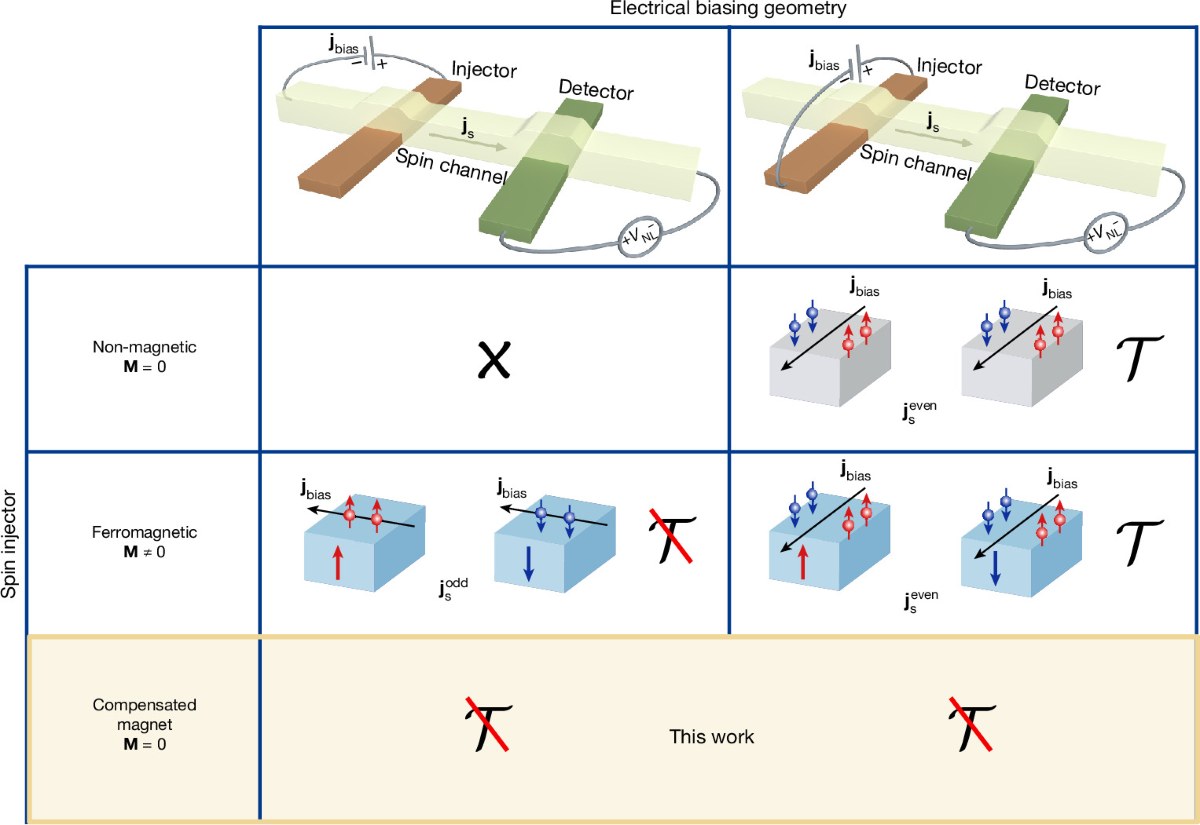
Spin injection from a compensated magnet that breaks time-reversal symmetry
Spin currents normally come either from ferromagnets, whose spin polarisation stems from a net magnetisation, or from relativistic effects such as the spin Hall effect. A team led by Fèlix Casanova at CIC nanoGUNE and Helena Reichlová at the Czech Academy of Sciences, with Tomáš Jungwirth, Libor Šmejkal and colleagues, used lateral spin-valve devices to inject spins electrically from Mn5Si3, a compensated magnet with vanishing net magnetisation, into a non-magnetic channel and detect them at a separate ferromagnetic electrode. Switching Mn5Si3 between its time-reversed magnetic states reverses the detected spin signal, in two different biasing geometries, a signature that differs from both ferromagnetic and spin-Hall injection. Calculations consistent with its altermagnetic order give spin polarisations of 6.5–10%, comparable to conventional ferromagnets, and modelling indicates spin diffusion lengths of 50–130 nm. The work includes a contributor from the University of Jyväskylä. Caveat: the key measurements were made at 100 K, and the altermagnetic interpretation rests on consistency with symmetry analysis and modelling.
Primary source: Mencos et al., Nature (published 28 Oct 2026).
X-ray evidence of chirality in altermagnetic MnTe
A SLAC-led team, working at the ID32 beamline of the European Synchrotron Radiation Facility, scattered left- and right-circularly polarised X-rays from manganese telluride and found a clear chiral signal that should not appear in a conventional antiferromagnet. In an altermagnet the lattice around “up” spins is rotated relative to that around “down” spins, which gives the electronic and magnetic structure a handedness that ordinary antiferromagnets lack. The team says the chiral signature was first seen in 2024 and reproduced in early 2025. Caveat: MnTe has been a leading altermagnet candidate for several years, so this strengthens rather than opens the case; the “conclusive proof” wording comes from the press release.
Primary source: Jost et al., Science (29 Oct 2026); press release via SLAC (29 Oct 2026).
Altermagnetic order and topological textures in four-unit-cell BiFeO3
Ultrathin multiferroic films usually lose their polar and magnetic order to depolarisation and magnetic dead layers. A collaboration led by Lucas Caretta (Brown) and Angela Wittmann (Mainz) grew BiFeO3 with no dead layer and found that short-circuit electrostatic boundary conditions and epitaxial strain drive a continuous, thickness-induced phase transition accompanied by multiferroic topological textures. At four unit cells a collinear monoclinic phase with d-wave altermagnetic order is stabilised, supported by magnetic circular dichroism imaging and spin-resolved photoemission. Caveat: the authors describe altermagnetic “signatures”; room-temperature device function at this thickness remains to be shown.
Primary source: Fratian et al., Nature Materials (published 28 Oct 2026).
A Chern metal at the onset of Kondo breakdown in MoTe2/WSe2
Jie Shan and Kin Fai Mak’s group at Cornell reports a Chern metal, a two-dimensional metallic state carrying chiral edge states, in angle-aligned MoTe2/WSe2 bilayers that behave as a frustrated moiré Kondo lattice. The state is compressible, with a nearly quantised Hall resistance alongside a finite longitudinal resistance from a bad-metallic bulk. Nonlocal transport and current-induced breakdown of the quantum anomalous Hall effect point to a chiral edge state, and magnetic circular dichroism shows a magnetisation plateau before a metamagnetic transition at the Kondo breakdown. Caveat: the bulk is a bad metal, so edge and bulk contributions have to be separated carefully; the interplay of topology and Kondo physics is still being worked out theoretically.
Primary source: Zhao et al., Science (First Release, 29 Oct 2026).
Preprints worth watching
Superconductivity alongside high-Chern-number insulators in twisted rhombohedral graphene
In a twisted rhombohedral bilayer–trilayer graphene moiré superlattice, the authors see superconductivity with a critical temperature of about 180 mK, a BKT temperature of 135 mK and phase-sensitive interference patterns, emerging near filling ν = −2 at zero displacement field. It survives in-plane fields up to 2 T, well beyond the Pauli limit, and competes with a correlated insulator depending on displacement field and twist angle. The same device shows integer Chern insulators with C = 1, 3 and −3. Caveat: preprint, and the pairing mechanism behind the strong Pauli-limit violation is not yet established.
Primary source: arXiv:2610.40170 (submitted 29 Oct 2026).
Meta-altermagnetism: a discontinuous jump in altermagnetic order
Bogeng Wen and Hae-Young Kee ask whether altermagnetism can switch abruptly, and find in a mean-field extended t–J model that it can when band reconstruction pushes spin-split van Hove singularities across the Fermi level. The resulting first-order transition creates an intermediate regime with reduced staggered magnetisation but a strongly enhanced magnetic octupole and spin-splitter conductivity, ending at a quantum critical endpoint. Caveat: a mean-field theory preprint without a specific material realisation.
Primary source: arXiv:2610.37754 (27 Oct 2026).
Also noted
Oak Ridge National Laboratory squeezed crystals of manganese telluride and iron sulfide between titanium plates and used neutron diffraction to show that the strain changes their altermagnetic domain populations and their anomalous Hall response, in back-to-back papers in Physical Review X and Advanced Materials: ORNL news (27 Oct 2026).
Nature Physics News & Views on two-dimensional altermagnetism realised in an orthogonally twisted van der Waals homostructure: Zhang and Song, Nature Physics (26 Oct 2026).
Exactly solvable spin-3/2 and spin-7/2 models give altermagnetic quantum spin liquids, with a g-wave phase as the unique ground state in one case: Sobral et al., Physical Review B 114, 235132 (28 Oct 2026).
Inelastic neutron scattering finds dispersive spin excitons in the magnetic Weyl semimetal NdAlSi whose energy, width and splitting change with each magnetic phase: Zhang et al., Physical Review Letters (accepted 27 Oct 2026).
Circularly polarised terahertz light separates two groups of Caroli–de Gennes–Matricon states trapped in vortex cores of FeTe1−xSex films, Rutgers and Tallinn: Rõõm et al., Physical Review Letters, via Phys.org (29 Oct 2026).
A suspended few-layer NiPS3 membrane reveals nematic zigzag states and magnon-dressed excitons that can be tuned with strain: Wolff et al., Nature Communications (27 Oct 2026, open access).
IMDEA Nanociencia grew two-dimensional islands of a 1H phase of NbTe2, which does not exist in the bulk, and found a 4 × 4 charge density modulation at low temperature; the work is in ACS Nano: report in Diario PYME (29 Oct 2026).
Preprints in this roundup should be read as provisional until the final peer-reviewed versions appear.