
Quantum materials this week: moiré electron crystals caught melting, spin fluctuations named as the pairing glue in electron-doped cuprates, and a field-tuned route into a quantum spin liquid
Science leads this week with a pair of scanning tunnelling microscopy papers that watch correlated moiré states form and then melt. Nature Physics adds transport evidence that antiferromagnetic spin fluctuations drive superconductivity in electron-doped cuprates, alongside a rich phase diagram in semimetallic rhombohedral graphene, and Science Advances reports a continuous transition from an ordered magnet into a spinon spin liquid. Preprints below await peer review unless a journal link is given.
Journal highlights
Watching moiré electron crystals and Chern insulators melt, atom by atom
Two groups used scanning tunnelling microscopy to image correlated phases in moiré superlattices and then tune them until they melt. Ali Yazdani’s team at Princeton, with Oskar Vafek, studied Bernal bilayer graphene fully aligned with hexagonal boron nitride in a magnetic field. They directly imaged interaction-driven, symmetry-breaking Chern insulators that double, triple or quadruple the moiré unit cell at fractional filling of the Hofstadter bands, and saw one Chern state melt through the proliferation of topological defects while another went through a transition accompanied by phase competition and separation. Michael Crommie’s group at Berkeley imaged generalised Wigner crystals and Mott insulators in near-60°-twisted MoSe2 bilayers and found a striking electron–hole asymmetry: hole-doped crystals melt into disordered states, whereas electron-doped ones melt into delocalised, liquid-like states. The authors trace this to the broken particle–hole symmetry of the moiré lattice; the Mott insulators melt without such asymmetry. Caveat: both are surface-imaging studies at low temperature, so links to bulk transport signatures remain to be drawn.
Primary sources: He et al., Science 394, 440–444 (22 Oct 2026) and Berger et al., Science 394, 450–454 (22 Oct 2026).
Spin fluctuations as the pairing glue in electron-doped cuprates
In conventional superconductors the critical temperature and the linear-in-temperature scattering rate are tied together by the electron–phonon coupling, but no equivalent link had been found in the cuprates. A team including Nigel Hussey, Kui Jin and Richard Greene used d.c. resistivity and high-field magnetoresistance on electron-doped La2−xCexCuO4 to extract a strongly anisotropic inelastic scattering rate that weakens markedly with doping, tracking the fall in critical temperature. They read this as identifying low-energy commensurate antiferromagnetic spin fluctuations as the main pairing glue. Caveat: the authors stress that the contrasting behaviour of hole-doped cuprates means their higher critical temperatures cannot be explained simply by stronger coupling to the same fluctuations.
Primary source: Duffy et al., Nature Physics (published 19 Oct 2026, open access).
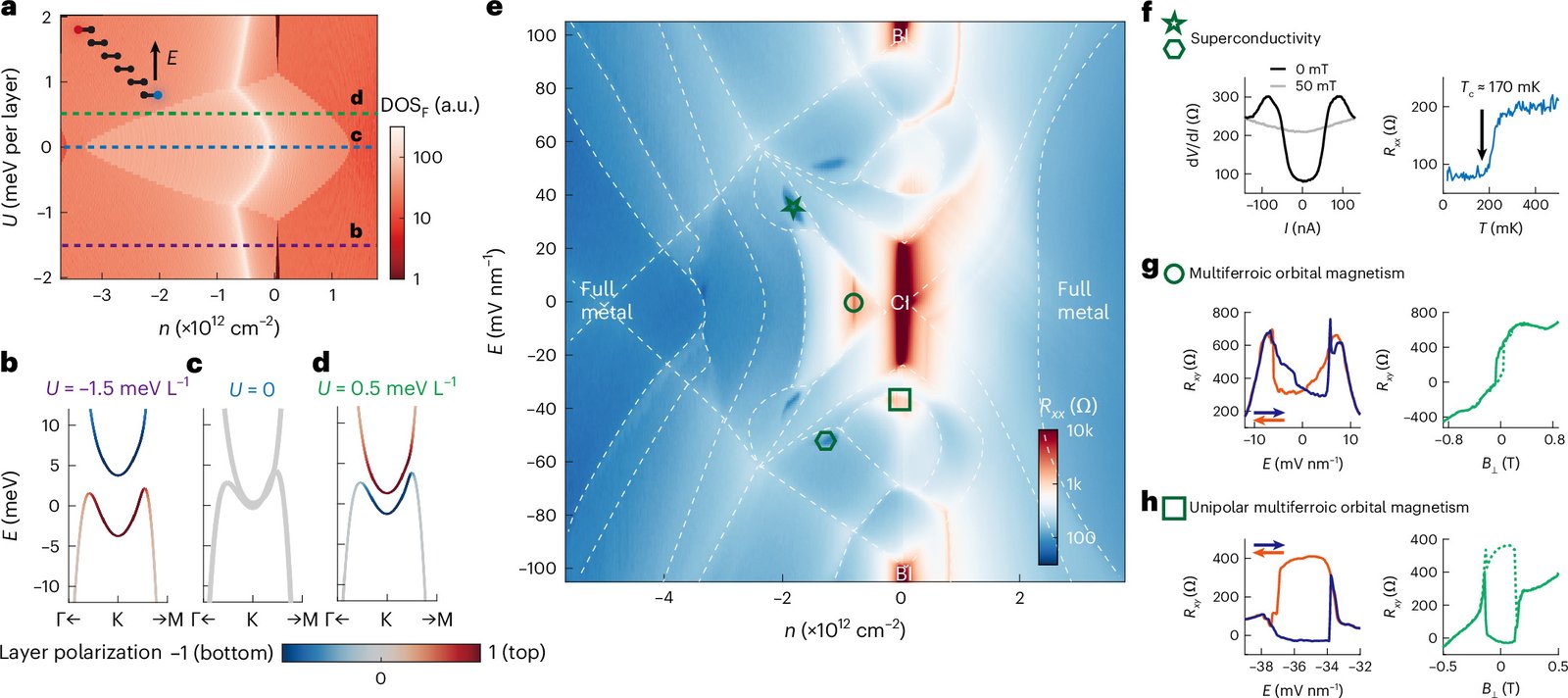
Superconducting pockets and ferroelectric orbital magnetism in semimetallic rhombohedral hexalayer graphene
Most work on rhombohedral multilayer graphene has looked at regimes where conduction and valence bands are separated. This study, from Xiaomeng Liu’s group with Kin Fai Mak and Jie Shan, explores the semimetallic regime of hexalayer graphene, where the bands overlap. It reveals correlated insulators, several pockets of superconductivity and two distinct multiferroic orbital magnetic orders. Near a band inversion, two superconducting-like states appear only where electron and hole Fermi surfaces coexist, hinting at a dual-carrier origin, and a ferroelectric orbital magnet switches sharply under unipolar electric fields with magnetic hysteresis that can be reversed electrically. Caveat: the authors call the superconducting states “superconducting-like”, and the dual-carrier mechanism is a suggestion rather than a demonstration.
Primary source: Deng et al., Nature Physics (published 21 Oct 2026).
A continuous transition from magnons to spinons in the triangular magnet TlYbS2
A Los Alamos-led team, with Purdue, Kyoto, Tokyo and TU Munich collaborators, reports that a modest c-axis field suppresses the 120° antiferromagnetic order in TlYbS2 (TN ≈ 0.53 K) and drives it into a gapless quantum spin liquid with a spinon Fermi surface. The evidence is a finite residual linear term in the thermal conductivity, reproduced on a second crystal, together with Pauli-like susceptibility and a temperature-independent NMR Knight shift down to about 0.1 K. Approaching the critical field from the spin-liquid side, heat transport is strongly suppressed while the density of states shows no critical enhancement, which the authors argue points to a continuous confinement–deconfinement transition beyond the Ginzburg–Landau picture. Caveat: critical exponents and scaling have not yet been established, and the microscopic origin of the field-induced spin liquid is open.
Primary source: Hosoi et al., Science Advances 12, eaej9484 (2026).
All-antiferromagnetic tunnel junctions switched by octupole-driven spin torque
PtMn3|MgO|PtMn3 junctions built entirely from noncollinear antiferromagnets show a room-temperature tunnelling magnetoresistance of 363% and can be switched by current at densities of around 10 MA cm−2. The authors attribute the switching to an imbalance between intra- and inter-sublattice spin currents linked to a nonzero cluster-octupole polarisation, a spin-transfer torque that needs no net magnetisation. Caveat: this is a device demonstration; endurance, scaling and the hoped-for terahertz operation are still to be shown.
Primary source: Kang et al., Nature (published 21 Oct 2026); preprint: arXiv:2509.03026.
Graphene-capped bismuthene keeps its quantum spin Hall edge states
Researchers at Chemnitz University of Technology intercalated one-atom-thick bismuthene islands between silicon carbide and a covering graphene layer. Scanning tunnelling spectroscopy at 4.5 K shows a bulk gap of about 0.5 eV with metallic states at the atomically defined edges, and density functional theory confirms that the weak interaction with graphene largely preserves the band structure. The edge spectra are consistent with a Tomonaga–Luttinger liquid. Caveat: as the team notes, low-loss transport along the protected edge channels has not yet been demonstrated.
Primary source: Ngo et al., ACS Nano 20 (40), 27472–27481 (2026); press release via Silicon Saxony (19 Oct 2026).
Preprints worth watching
An extended strange metal and a new superconducting dome in twisted bilayer WSe2
Moving far from the half-filled Mott insulator usually studied in moiré Hubbard systems, this work reports an extended strange metal across a wide range of doping and twist angle in a partially filled Hubbard band of twisted bilayer WSe2. It is in the clean limit, persists down to about 50 mK, spans several symmetry-breaking ground states and appears only at small twist angles, which the authors argue makes it an intrinsic state of matter rather than a quantum-critical one. A new superconducting dome develops out of it, away from both the Mott insulator and the van Hove singularity. Caveat: preprint; the “intrinsic state” interpretation will need theoretical and independent experimental scrutiny.
Primary source: arXiv:2610.22307 (submitted 15 Oct 2026).
A short localisation length keeps Majorana candidates at zero energy in Cr chains on Bi2Pd
Chromium chains built atom by atom on the Bi-terminated surface of Bi2Pd show, as they lengthen, a closing and reopening of the in-gap spectrum followed by zero-bias modes localised at the chain ends. The residual splitting gives a localisation length of about three atomic sites, which the authors say suppresses the hybridisation that normally pushes end modes away from zero energy in finite chains. Caveat: zero-bias end modes alone do not prove Majorana character, and this is a preprint.
Primary source: arXiv:2610.29446 (submitted 21 Oct 2026).
Why bilayer nickelate films show two-step superconducting transitions
Ambient-pressure bilayer nickelate films on SrLaAlO4 superconduct above 40 K but often show incomplete zero resistance or two-step transitions. This study links those features to superconducting weak links at substrate step terraces: the two-step transition follows the terrace orientation, atomic-scale imaging shows disrupted regions at the steps, and the terrace width even decides whether the film superconducts at all. A useful practical explanation for anyone comparing nickelate film data, including the half-dome result we covered last week. Caveat: preprint.
Primary source: arXiv:2610.27729 (submitted 20 Oct 2026).
Broken time-reversal symmetry in the nonsymmorphic superconductor RuB2
Zero-field muon spin relaxation reveals spontaneous internal fields below Tc = 1.6 K in RuB2, while transverse-field data point to a full, close-to-BCS gap. Calculations describe RuB2 as a multiband Z2 topological metal, and a Ginzburg–Landau analysis suggests a nonunitary spin-triplet order parameter. Caveat: the authors note that the data narrow the candidates but do not uniquely determine the pairing state.
Primary source: arXiv:2610.26264 (submitted 19 Oct 2026).
Also noted
A symmetry-broken Chern insulator with integer quantised Hall conductance at fractional filling 4/3 appears near a field-induced Kondo breakdown in MoTe2/WSe2 moiré bilayers: Physical Review Letters (13 Oct 2026).
Tohoku University and NIMS used a strontium titanate variable capacitor for impedance matching, enabling fast, sensitive charge readout of highly resistive 2D-material quantum dots that stays stable in a perpendicular magnetic field: Tohoku University press release (19 Oct 2026).
Intercalating the amino acid arginine between tantalum disulfide layers stabilises the commensurate charge density wave up to about 57 °C, far above its usual range: UCLA California NanoSystems Institute (20 Oct 2026).
Preprints in this roundup should be read as provisional until the final peer-reviewed versions appear.