
Quantum materials this week: an altermagnet seen atom by atom, fractional spins meeting a superconductor and ambient-pressure bulk nickelate superconductivity
This week’s roundup is led by two Nature papers that use scanning tunnelling microscopy in new ways: a topological crystal turned into a spin-sensitive tip to image a two-dimensional altermagnet, and carbon-based Haldane chains whose fractional edge spins couple to a superconductor only when the chain length is odd. Science adds a gate-tunable collective spin mode in a TMD moiré lattice, and the preprint servers bring bulk nickelate superconductivity at ambient pressure. Preprints below await peer review unless a journal link is given.
Journal highlights
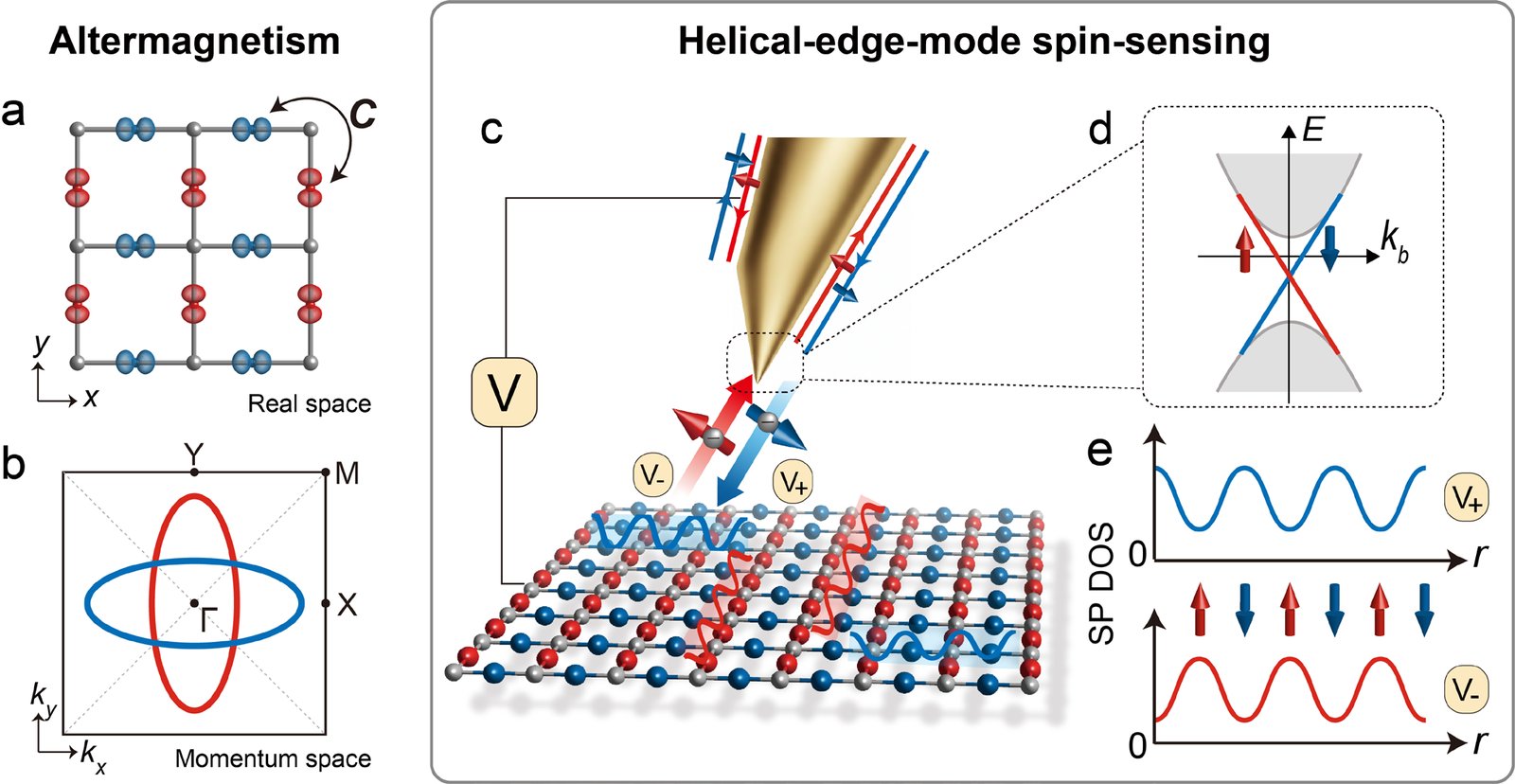
A topological STM tip reveals d-wave altermagnetism in KV2Se2O
A USTC-led team, with HKUST collaborators, used the helical edge modes of the higher-order topological insulator α-Bi4Br4 as a spin-selective scanning tunnelling probe. On the surface layer of the candidate altermagnet KV2Se2O, atomically registered maps show the two vanadium sublattices, a density-wave lattice modulation and real-space patterns consistent with checkerboard antiferromagnetic order. Field-dependent spectroscopy finds opposite energy shifts for quasiparticle excitations along two orthogonal crystal axes, and spin-sensitive quasiparticle interference shows a bias-reversing d-wave anisotropy between the X and Y valleys. Caveat: the authors describe this as converging evidence for altermagnetism in the surface layer, so it does not on its own settle the bulk order, and the paper is an Accelerated Article Preview.
Primary source: Wang et al., Nature (published 13 Oct 2026); press release: Chinese Academy of Sciences.
Fractional edge spins of molecular Haldane chains couple to a superconductor only at odd length
Researchers grew Haldane chains of antiferromagnetically coupled spin-1 triangulene units on a proximitised Au(111)/Nb(110) surface and probed them with scanning tunnelling spectroscopy. Odd-length chains have an S = 1 ground state and host Yu–Shiba–Rusinov bound states inside the superconducting gap, whereas even-length chains form an S = 0 ground state that decouples from the superconductor. A two-site model traces the alternation to the sign and strength of the interaction between the two spin-1/2 edge states, which is independently confirmed by spin excitations outside the gap. The authors see this as a route to molecular spin qubits built from π-conjugated carbon. Caveat: this is a surface-science demonstration on short chains at very low temperature; qubit operation is not shown.
Primary source: Vaxevani et al., Nature (published 14 Oct 2026).
A gate-tunable chiral spin mode in WSe2/WS2 moiré superlattices
Zhejiang University researchers used polarisation-resolved Raman spectroscopy on near-0°-twisted WSe2/WS2 bilayers to find a chiral spin mode, a collective spin-flip excitation between spin–orbit-split conduction minibands. It appears as a sharp resonance with very large Raman efficiency, its spin-flip character is confirmed by the Zeeman effect, and as the filling changes it evolves from a chiral spin exciton into an excitonic polaron. The filling dependence also points to a charge-transfer insulator at unity filling. Caveat: the mode is identified optically; its link to transport or to correlated ground states is still to be explored.
Primary source: Shan et al., Science 394, 316–320 (15 Oct 2026).
“Carpet-mode” growth delivers uniform 2D topological insulator films of bismuth telluride
A University of Chicago team, with Northwestern collaborators, grew millimetre-scale, uniform-thickness bismuth telluride films by molecular beam epitaxy in a growth mode where the film drapes continuously over the substrate’s atomic steps. Using several kinds of spectroscopy, including ultrafast coherent-phonon measurements and scanning tunnelling spectroscopy of the edges, they report what the senior author calls conclusive spectroscopic evidence that the ultrathin films are a two-dimensional topological insulator. Earlier films mixed one to four layers, which blurred the topological signatures. Caveat: the evidence is spectroscopic; quantised edge transport has not been reported here.
Primary source: Lee et al., ACS Nano (2026); press release: UChicago Pritzker School of Molecular Engineering (12 Oct 2026).
A superconducting half-dome in bilayer nickelate films
By tuning oxygen stoichiometry continuously in compressively strained bilayer nickelate thin films, this study finds a half-dome rather than a full dome. Adding oxygen beyond the optimum gradually suppresses superconductivity towards a metal, while removing oxygen drives a granular superconductor-to-insulator transition but leaves the onset temperature intact. The authors attribute the asymmetry to interstitial oxygen acting mainly as a dopant and vacancies acting mainly as scatterers, and they see the same pattern across several rare-earth combinations, with and without alkaline-earth doping. Caveat: this is an accepted manuscript, so the final version may still change.
Primary source: Phys. Rev. X, accepted 15 Oct 2026.
A small twist improves a superconducting diode for qubit circuits
A twisted NbSe2 device acts as a superconducting quantum diode under combined in-plane and out-of-plane magnetic fields, and a twist of only about 1° raises the diode efficiency to 27.6%, above that of untwisted devices. Simulations suggest that this intermediate efficiency, rather than ideal 100% rectification, is the best choice for preserving qubit anharmonicity and stabilising two-level systems. Caveat: the qubit benefit is shown in simulation; no qubit was built with the diode.
Primary source: Zhong et al., Nature Communications (published 10 Oct 2026, open access).
Preprints worth watching
Bulk nickelate superconductivity at ambient pressure in La6Ni5O12
Xianhui Chen’s group at USTC reports ambient-pressure bulk superconductivity in the quintuple-layer square-planar nickelate La6Ni5O12, made by topotactic reduction of the Ruddlesden–Popper compound La6Ni5O16. The onset is about 18 K, with zero resistance, diamagnetic shielding, vortex-pinning hysteresis and a specific-heat anomaly. Until now nickelate superconductivity has needed thin films or high pressure, so a bulk sample at ambient pressure would open the door to many more probes. Caveat: the superconducting volume fraction is about 25% in a polycrystalline pellet, so phase purity and single crystals are the next things to watch.
Primary source: arXiv:2610.20249 (submitted 14 Oct 2026).
Quantum spin ice leaves a fingerprint on Weyl Fermi-arc transport
A Rutgers-led team grew atomically sharp interfaces between the Weyl semimetal Eu2Ir2O7 and the quantum-spin-ice candidate Tb2Ti2O7. At 20 mK the angular magnetoresistance changes from sixfold at low field to twelvefold in an intermediate window around 7 T, then back to sixfold at high field. The classical spin-ice interface with Dy2Ti2O7 shows no twelvefold response, which the authors link to the transverse, multipolar degrees of freedom of the Tb moments. Caveat: the interpretation rests on a phenomenological two-channel model, and the Tb2Ti2O7 response is known to depend on stoichiometry and film thickness.
Primary source: arXiv:2610.12294 (submitted 8 Oct 2026).
Theory to note
Transdimensional Chern insulators in rhombohedral graphene moiré superlattices
Hartree–Fock calculations suggest that the transdimensional orbital ferromagnetic metal recently seen in lightly doped rhombohedral multilayer graphene can turn into a quantised Chern insulator once a moiré potential from aligned hBN is added. The state carries both in-plane and out-of-plane orbital magnetisation, and the authors predict soft density-wave modes and, at fractional filling, a possible fractional Chern insulator that breaks rotation and mirror symmetries. Caveat: mean-field theory only.
Primary source: arXiv:2610.21310 (submitted 15 Oct 2026).
A hidden Zeeman field in odd-parity magnets
Researchers at the Hefei High Magnetic Field Laboratory and HKUST identify a hidden Zeeman field in the band structures of odd-parity magnets that can reach hundreds of millielectronvolts. Because a large spin splitting locks the spin direction at right angles to this field, much as in Ising superconductors, conventional s-wave superconductivity can survive beyond the Pauli limit, and the team builds field-free topological superconducting phases with Majorana flat bands and unidirectional edge states. The work appeared in Physical Review Letters as an Editors’ Suggestion. Caveat: theory and mean-field calculations; candidate materials still need to be tested.
Source: Chinese Academy of Sciences press release (10 Oct 2026).
Also noted
Picosecond current pulses reveal the intrinsic depairing limit in s-wave NbN, while d-wave YBa2Cu3O7 shows a more gradual suppression: Wang et al., Nature Physics (8 Oct 2026), with a research briefing.
Fluorescent defects in hexagonal boron nitride detect single ions in liquids, telling Li+, Na+, Mg2+ and Al3+ apart by their spectral shifts, with millisecond time resolution down to about 10 µM: Wu et al., Nature Sensors (7 Oct 2026).
A new review sets out how to tell genuine excitonic insulators apart from charge-density-wave, Mott and hybridisation-driven insulators: Nature Reviews Physics (8 Oct 2026).
Preprints and accepted manuscripts in this roundup should be read as provisional until the final peer-reviewed versions appear.