
Quantum materials this week: chiral superlattices, a time-breaking type-I superconductor and magnons that sense superconductivity
Weekly roundup for 2 to 9 October 2026. Journal papers are peer reviewed; arXiv items are preprints and have not yet been through peer review, so treat their claims as provisional.
Journal highlights
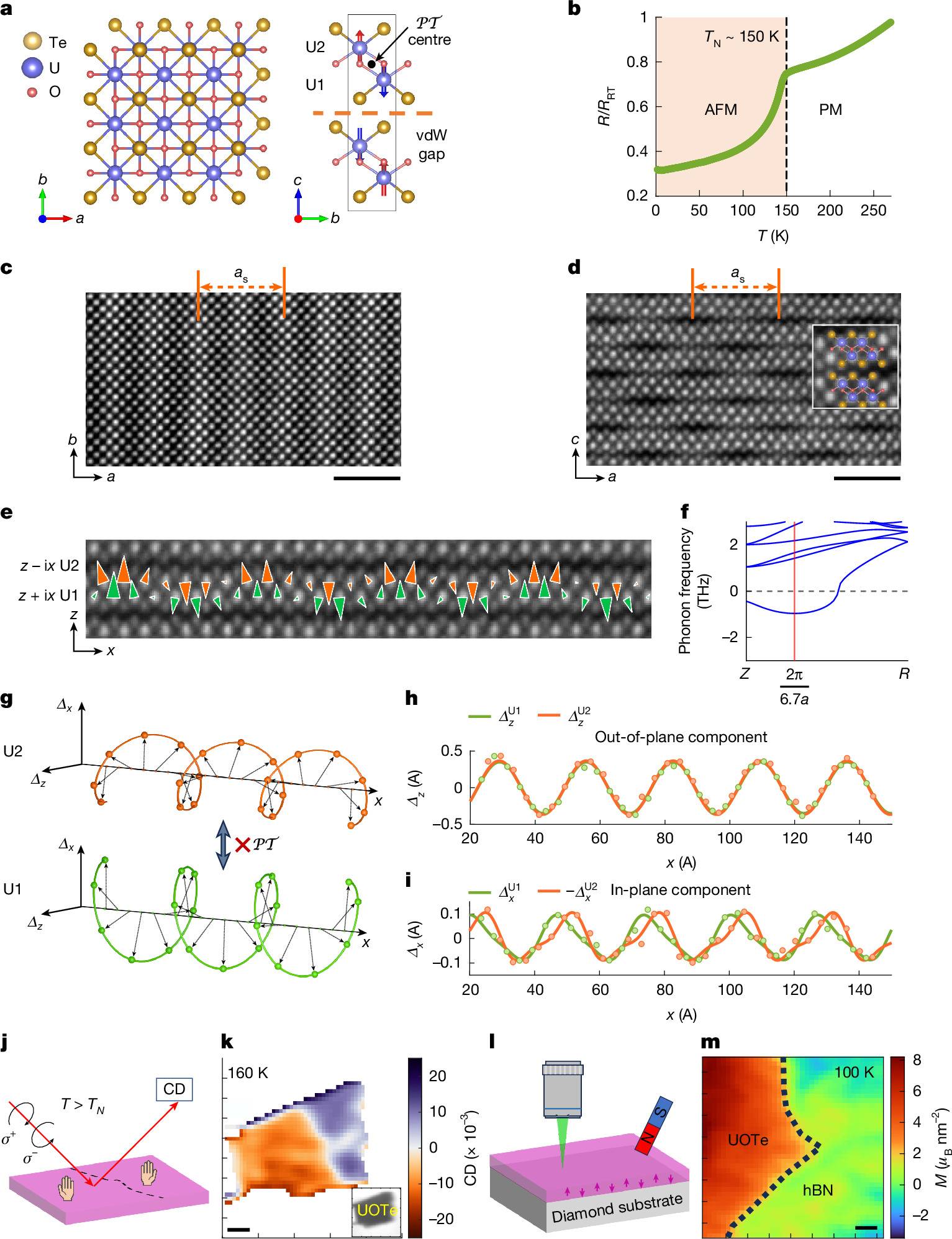
A chiral superlattice gives a collinear antiferromagnet spin-split, topological bands
In the collinear antiferromagnet UOTe, a spontaneous chiral superlattice formed by frozen chiral phonons generates large Berry curvature (seen through the nonlinear Hall effect), an anomalous Hall angle of about 0.14 near the Néel temperature, and spin-polarised current, none of which the pristine antiferromagnet would allow. The authors also propose a design rule for finding similar bond-mismatch superlattices. Nature, published 7 October 2026.
YbSb₂: the first type-I superconductor reported to break time-reversal symmetry
Muon spin relaxation on YbSb₂ crystals (Tc about 0.95 K) shows a spontaneous internal field of roughly 0.44 G appearing just below the transition, while transverse-field measurements confirm a fully gapped type-I state. Calculations point to a nonunitary triplet pairing state that could host gapless Majorana surface modes; that topological part is theory for now, while the time-reversal symmetry breaking is the experimental result. Physical Review Letters, with the arXiv preprint (2601.07460) and ScienceAlert coverage.
Twisting a ferromagnetic metal creates polarisation vortices
Twisted bilayer membranes of metallic SrRuO₃ host dipolar vortices despite free charge, tied to moiré-periodic flexoelectricity from shear strain gradients. Below the Curie temperature, ferromagnetism and the dipolar order appear to compete, with opposite twist-angle dependences. This takes topological polarisation textures beyond insulators and into metals. Nature Materials, published 2 October 2026.
Preprints worth watching
Magnons as remote, contactless probes of superconducting phase stiffness
Propagating antiferromagnetic magnons in CrSBr, launched and read out optically, speed up when the crystal sits on underdoped Bi₂Sr₂CaCu₂O₈₊δ below Tc, and the speed-up quantitatively tracks the superfluid phase stiffness via Meissner screening. With a parallel magnetic field, the team observes the universal stiffness jump of a Berezinskii–Kosterlitz–Thouless transition in a bulk cuprate. Teams include Xiaodong Xu, Joseph Orenstein and Zhi-Xun Shen. arXiv:2610.08934 (6 October).
Twist angle you can dial in situ: MEMS-rotated bilayer graphene
Two separately made graphene layers are assembled and rotated continuously on a micro-electromechanical stage, with Raman spectroscopy confirming the moiré potential, mapping the folded phonon dispersion and tracking angle-dependent band hybridisation. The aim is to remove device-to-device variability from twistronics. From Yuan Cao, Amir Yacoby and colleagues. arXiv:2610.07429 (5 October).
Magnetic fields pull generalised Wigner crystals in twisted MoTe₂ in opposite directions
In layer-polarised twisted MoTe₂, a perpendicular field suppresses the resistance peak at two-thirds hole filling while boosting the one-third peak by several orders of magnitude, which the authors attribute to different magnetic lattices in the two charge crystals. Near half filling a distinct, strongly anisotropic state appears that is consistent with a stripe phase. arXiv:2610.02493 (1 October).
Long-range supercurrent through the altermagnet CrSb
Josephson junctions built on strained epitaxial CrSb films carry a dissipationless supercurrent across a 150 nm gap, about two orders of magnitude beyond the usual singlet coherence length, with a clean field-modulated interference pattern as evidence of true Josephson coupling. It points to altermagnets as stray-field-free hosts for superconducting spintronics. arXiv:2610.11341 (8 October).
Kagome superconductor keeps its two pressure domes even without charge order
Ta-doped Cs(V₀.₈₆Ta₀.₁₄)₃Sb₅, which has no charge density wave and a higher Tc of about 5.3 K, still shows two superconducting domes up to 48 GPa, peaking at 5.7 K near 0.6 GPa and recovering to about 4.5 K at 47.7 GPa. That suggests the double-dome behaviour in the AV₃Sb₅ family is not driven by the charge order alone. arXiv:2610.12257 (8 October).
Floquet band dressing seen in a bulk metal
Time- and angle-resolved photoemission on 2H-NbSe₂ finds photon-shifted replicas of the bulk metallic bands that exist only while pump and probe overlap, with pump polarisation steering weight between momentum branches in a way that fits coherent Floquet–Volkov interference. Strong screening had cast doubt on whether this was possible in bulk metals. arXiv:2610.04958 (4 October).
Theory to note
Substrate-supported bilayer nickelate films could host mirror-protected, time-reversal-invariant topological superconductivity with a Majorana Kramers pair at the edge, according to a model built from first-principles band structures of La₃Ni₂O₇ films. arXiv:2610.03601.
A quantitative study suggests Landau-level mixing plus short-range interactions can stabilise a strongly paired composite-fermion state, offering an explanation for the incompressible half-filled states recently seen in monolayer and trilayer graphene. arXiv:2610.03921.