
Kagome Antimonene, Twisted Graphite Topology and Chiral Pairing Clues
This Friday’s quantum-materials roundup stretches from a chemically simple two-orbital kagome monolayer to stacking-engineered topology in large-angle twisted graphite, with kagome superconductivity supplying both a Hartree-scale local-moment rethink and phase-sensitive pairing clues. Preprints below await peer review unless a journal link is given.
Elemental kagome antimonene realises the minimal two-orbital model
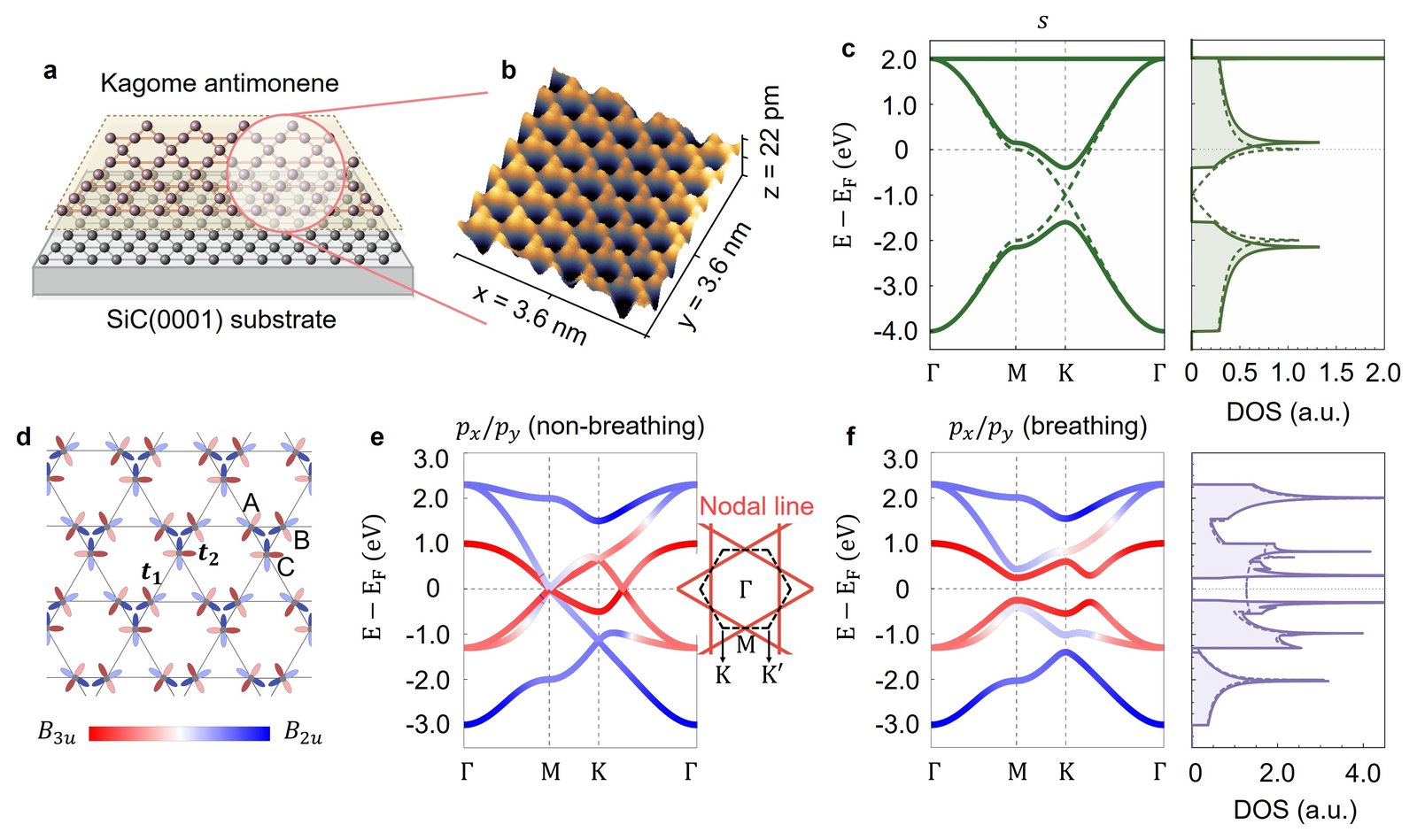
Würzburg-led STM, ARPES and theory work reports a truly two-dimensional, elemental two-orbital kagome system: monolayer Sb on SiC(0001). Substrate orbital filtering isolates in-plane Sb px/py states into a six-band manifold; chemically enforced half filling pins the Fermi level to a closed nodal line, driving a unit-cell-conserving breathing distortion and a large insulating gap. Energy-resolved LDOS maps further show orbital-resolved atomic obstruction—individual orbital manifolds look obstructed, while the combined half-filled valence manifold is non-obstructed. Caveat: this is a model-platform insulator rather than a bulk kagome metal, and the topological atomic-limit diagnosis rests on Wannier/Wilson-loop analysis plus STM contrast.
Primary source: arXiv:2609.31063 (submitted 25 Sep 2026).
Stacking-controlled topology in large-angle twisted graphite
Li, Chen and Yao show that large-angle twisted graphite sits outside the usual moiré local-stacking picture: inequivalent rotation centres define distinct commensurate interfaces whose interlayer hybridisation is set by intervalley Umklapp tunnelling. A symmetry-constrained model for a mixed D6–D3 stack at 21.8° yields one- and two-ring nodal-line phases and a C3-protected higher-order topological insulator when sublattice symmetry is intact. DFT plus atomistic calculations identify the equilibrium structure as a HOTI with hinge states; hydrostatic compression drives a transition into a Weyl-semimetal phase whose charges reverse with structural chirality. Caveat: the materials realisation is computational (DFT/tight-binding), and the ideal nodal rings gap under realistic sublattice-breaking perturbations.
Primary source: arXiv:2609.39094 (submitted 30 Sep 2026).
Local ionic moments in AV3Sb5 and ATi3Bi5 kagome superconductors
A Phys. Rev. X study argues that both V and Ti ions sit at a robust 2+ valence, so the two kagome families share similar itinerant carrier densities while the electron-count difference lives mainly in fluctuating ionic moments (spin-3/2 on V, spin-1 on Ti). Because geometric frustration and fast carrier-induced fluctuations hide those moments from standard probes, the team uses nonmagnetic Sn doping to locally relieve frustration and then tracks Curie–Weiss susceptibility and μSR. The data support a paradigm shift from a purely itinerant picture toward a spin–fermion description of CDW, nematicity and broken time-reversal signatures. Caveat: moments are revealed only near impurities or defects; stoichiometric crystals remain hard to diagnose, and the Hartree-scale starting point does not by itself fix low-energy pairing.
Primary sources: arXiv:2609.11927 (submitted 10 Sep 2026); journal: Phys. Rev. X 16, 031064 (2026).
Doping-tuned topological superconducting transition in a misfit NbSe2 compound
In the bulk misfit (LaxPb1−xSe)1.14(NbSe2)2, chemical doping through the rocksalt block drives a non-monotonic superconducting phase diagram: conventional multiband s-wave behaviour at low doping collapses near x ≈ 0.4, then a disorder-sensitive V-shaped gap reappears at higher doping. Spatially resolved STS finds orientation-selective in-gap modes at atomic step edges only in the high-doping regime; BdG nanoribbon calculations favour a time-reversal-symmetric crystalline-topological (mirror-protected) order parameter over a generic chiral edge mode. Caveat: several unconventional symmetries remain hard to exclude from gap line-shapes alone, and interlayer coupling plus broken C3v symmetry in the real misfit complicate a strict topological assignment.
Primary source: arXiv:2609.07545 (submitted 7 Sep 2026).
Impurity spectroscopy points to chiral pairing in optimally doped RbV3Sb5
STM on optimally Sn-doped RbV3Sb5 (CDW suppressed) finds a fully gapped, two-gap superconducting state. Nonmagnetic impurity-bound states show pronounced particle–hole asymmetry and resonances between the two gap scales—features that microscopic calculations reproduce for chiral d+id pairing but not for conventional s++ or generic s±. The work frames impurity-bound-state spectroscopy as a phase-sensitive probe for kagome superconductors. Caveat: this is a late-August preprint included for its high-impact claim; magnetic-impurity alternatives and sample-to-sample doping inhomogeneity still need independent checks, and direct BTRS probes on the same crystals are not yet reported.
Primary source: arXiv:2608.28848 (submitted 28 Aug 2026).
Why Floquet topological gaps in graphene stay hard to see
A non-phenomenological electron–phonon treatment of circularly driven graphene argues that large zero-point motion and optical phonons substantially broaden Floquet bands, shrink topological Floquet gaps by about half, and—with non-Γ modes plus realistic instrumentation broadening—can close the gap signature in photoemission. The authors propose mitigation via coherent phonon pre-pumping or moving to Dirac materials with more favourable phonon statistics, while suggesting that localised Floquet topology may still show up in transport. Caveat: purely theoretical; it explains a null result rather than reporting a new topological phase.
Primary source: arXiv:2609.39817 (submitted 30 Sep 2026).
Several of these items are preprints and should be read as provisional until peer-reviewed journal versions appear.