
QMAT Friday: pairing next to Chern bands, and magnetism hiding inside UTe₂
This week’s quantum-materials roundup is led by transport in twisted Bernal bilayer–trilayer graphene, where incipient superconductivity sits in the same gate map as tunable Chern insulators, and by pressure experiments that uncover a hidden magnetic order inside the superconducting dome of UTe₂. Theory contributions map multi-order Majorana modes in 2M-WS₂ films, topological pairing in twisted TMD bilayers, and orbital-anti-phase nodes in bilayer nickelates. All arXiv items below are preprints unless otherwise noted.
Incipient superconductivity next to tunable Chern insulators in twisted Bernal bilayer–trilayer graphene
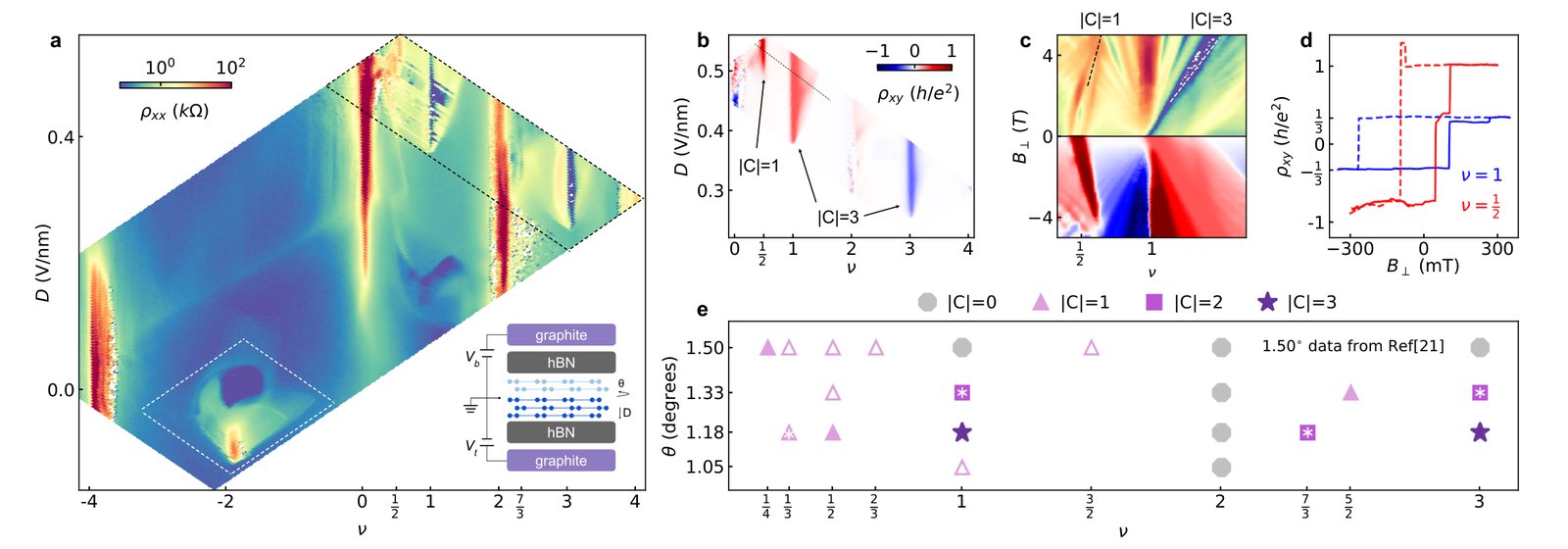
Waleffe, Bhattacharyya, Yankowitz and colleagues report that twisted Bernal bilayer–trilayer graphene encapsulated in hBN hosts both Chern insulators (Chern numbers up to |C| = 3, set by twist angle and doping) and a displacement-field-driven pocket of incipient superconductivity near ν = −2. The pocket shows a sharp resistive drop, critical current and Tc peaking near 160 mK at the insulator boundary, yet the resistance does not fall fully to zero; in-plane field expands the pocket beyond four times the weak-coupling Pauli limit and stabilises Fraunhofer-like critical-current modulation consistent with phase-coherent pairing. The result is notable because superconductivity in twisted Bernal multilayers had largely been missing without a TMD substrate, and because pairing and electrically tunable topology now share one phase diagram. Caveat: preprint; residual resistance leaves open disorder versus anomalous-metal interpretations.
Primary source: arXiv:2609.30202 (submitted 24 Sep 2026).
Hidden magnetic order inside the pressure-induced superconducting dome of UTe₂
Ye, Smidman, Yuan and co-workers use ac susceptibility and calorimetry under pressure to resolve a magnetic transition (likely antiferromagnetic) that develops inside the SC2 superconducting dome of the candidate spin-triplet superconductor UTe₂. The hidden order’s phase boundary extrapolates toward a zero-temperature quantum critical point near the SC2 Tc maximum (~1 GPa), and both superconductivity and the hidden order vanish once three-dimensional antiferromagnetism onsets near 1.5 GPa. The work reframes which magnetic fluctuations may drive the pressure-induced triplet phase—distinct from the ambient-pressure electrical superconducting-memory result covered earlier this month.
Primary source: arXiv:2609.29168 (submitted 24 Sep 2026).
First-, second- and third-order Majorana modes coexisting in C₂ₕ topological-superconductor films
Ding, Qin, Cui, Zhang and collaborators theoretically show that C₂ₕ-symmetric topological-superconductor films—motivated by 2M-WS₂—proximity-coupled to magnetic insulators can host vortex, chiral-edge and corner Majorana modes in a single platform. Film thickness and exchange-field penetration control interconversion among first-, second- and third-order modes; crystalline symmetry keeps corner modes decoupled from the interfacial chiral mode, and an out-of-plane electric field can switch topologies in the ultrathin limit. Caveat: purely theoretical; experimental braiding or spectroscopy still required.
Primary source: arXiv:2609.24311 (submitted 21 Sep 2026).
Topological paired state in twisted TMD bilayers from a two-band Kane–Mele model
Saha and Zegrodnik treat superconductivity in twisted TMD bilayers with an effective two-band Kane–Mele-like model plus Coulomb and intersite exchange pairing at Hartree–Fock level. They find a mixed singlet d+id / triplet p−ip state whose stability tracks the van Hove singularity, and a displacement-field-driven topological transition of the paired bands from total Chern number C = 4 to C = 2. The calculation speaks directly to recent experiments on twisted WSe₂ and MoTe₂. Caveat: mean-field theory; competition with Mott, magnetic and fractional Chern states is left for future work.
Primary source: arXiv:2609.21825 (submitted 18 Sep 2026).
Orbital-anti-phase superconductivity and accidental nodes in bilayer nickelates
Scholten, Fernandes, Eremin and colleagues analyse an orbital-anti-phase gap structure in bilayer nickelates (La₃Ni₂O₇ family), where a π phase shift between dₓ²−y² and d₃z²−r² pairing components can generate accidental nodes on the mixed-orbital α/β Fermi sheets. They predict a distinctive low-temperature superfluid-stiffness curve as a clear experimental test, complementary to ARPES. Caveat: theory with phenomenological gap fits; which orbital phase is realised experimentally remains open.
Primary source: arXiv:2609.29263 (submitted 24 Sep 2026).