
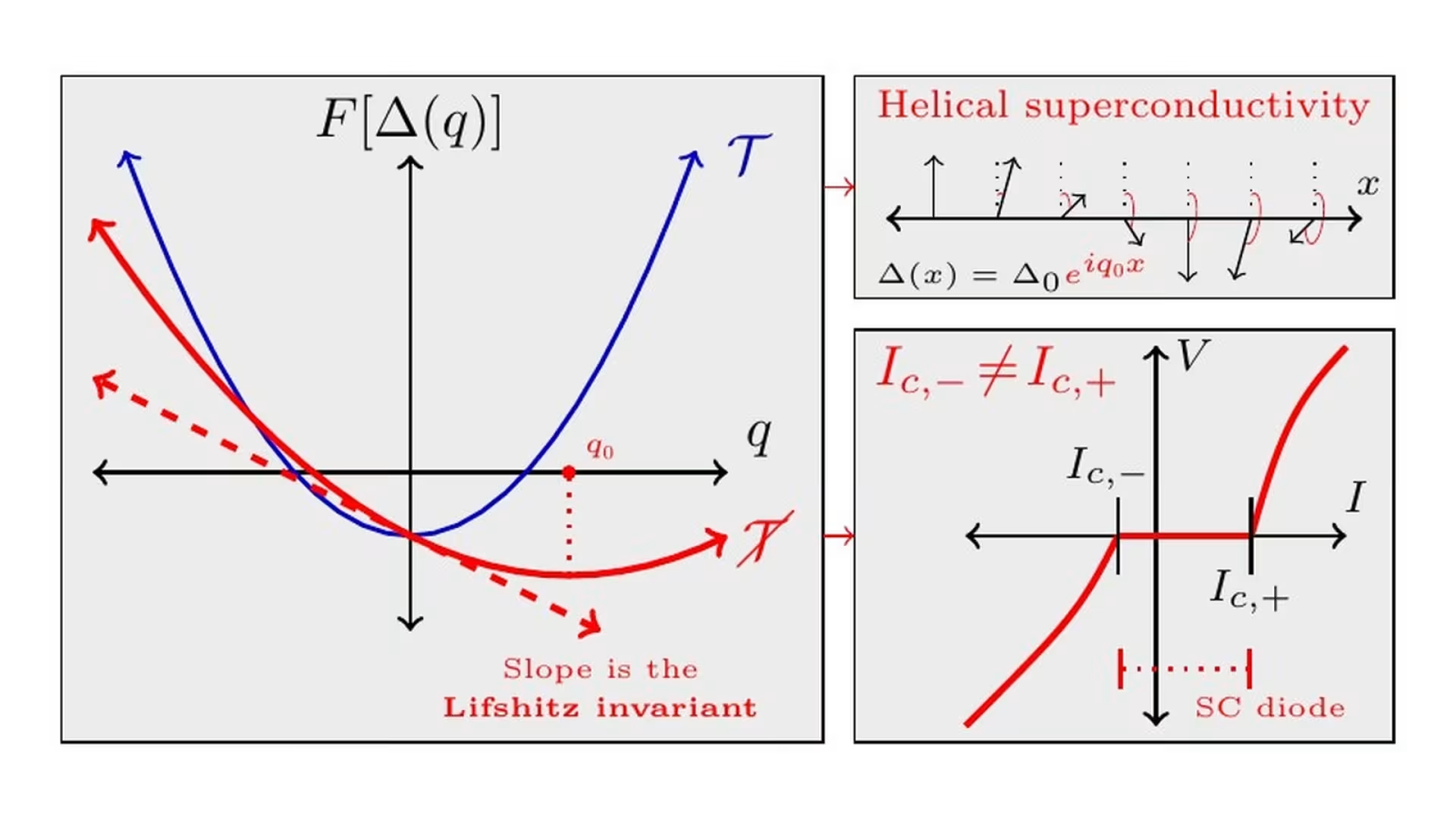
Effects such as helical superconductivity and the superconducting diode effect rely on breaking time-reversal symmetry, which theory captures through a term in the free energy known as the Lifshitz invariant. In ordinary single-band superconductors, this term comes from asymmetries of the electronic spectrum near the Fermi surface.
Aaron Dunbrack, Pauli Virtanen and Tero Heikkilä of QMAT's Condensed Matter Theory group at the University of Jyväskylä show that in multi-band superconductors the quantum geometry of the electronic states also contributes, and that it becomes the dominant contribution when the low-energy bands are flat. They also demonstrate analogous quantum-geometry-driven transitions between commensurate and incommensurate charge and pair density waves. The result points to quantum geometry as a key ingredient of flat-band superconductivity.
Figure: Dunbrack et al., Phys. Rev. B (2026); image from arXiv:2503.14721, CC BY 4.0