
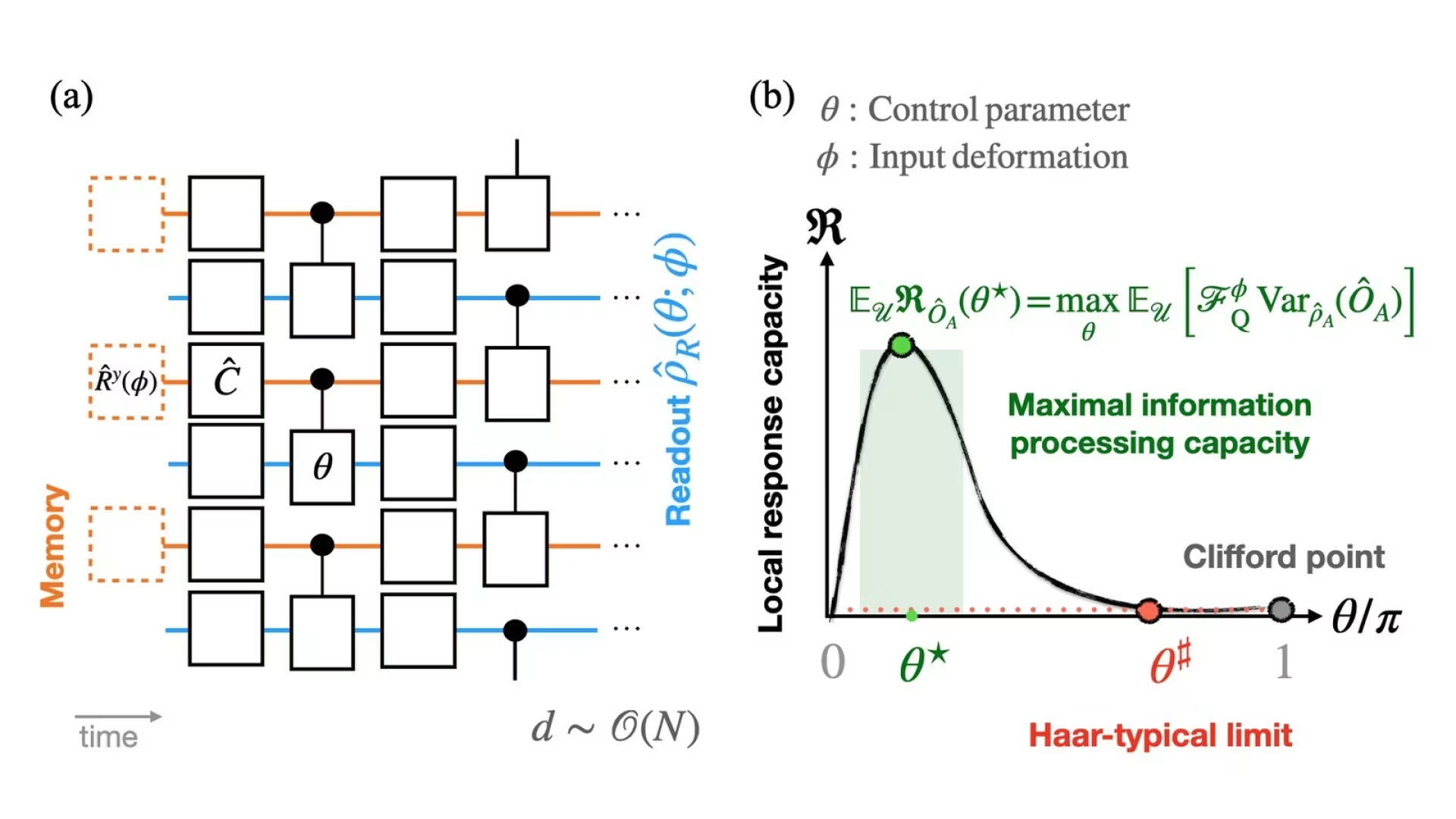
How does the complexity of a quantum system relate to its usefulness for computation? Studying a family of minimally tunable quantum circuits, Matias Karjula, Teemu Ojanen, Tapio Ala-Nissila and Moein Ivaki find an intermediate 'learning phase' that appears before the onset of quantum chaos.
This phase is marked by a strongly non-flat spectrum and highly sensitive readout states, features that directly control the typical information-processing power of the circuits. The optimal capacity grows with system size, while deep scrambling suppresses the observable response. The results suggest that features of random quantum dynamics can serve as resources for scalable nonlinear computation, with relevance to quantum learning and sensing. The work links Teemu Ojanen's Theory of Quantum Matter group at Tampere University with Aalto University.
The preprint has not yet been peer reviewed.
Figure: Karjula et al., arXiv:2608.20155 (2026), CC BY 4.0