
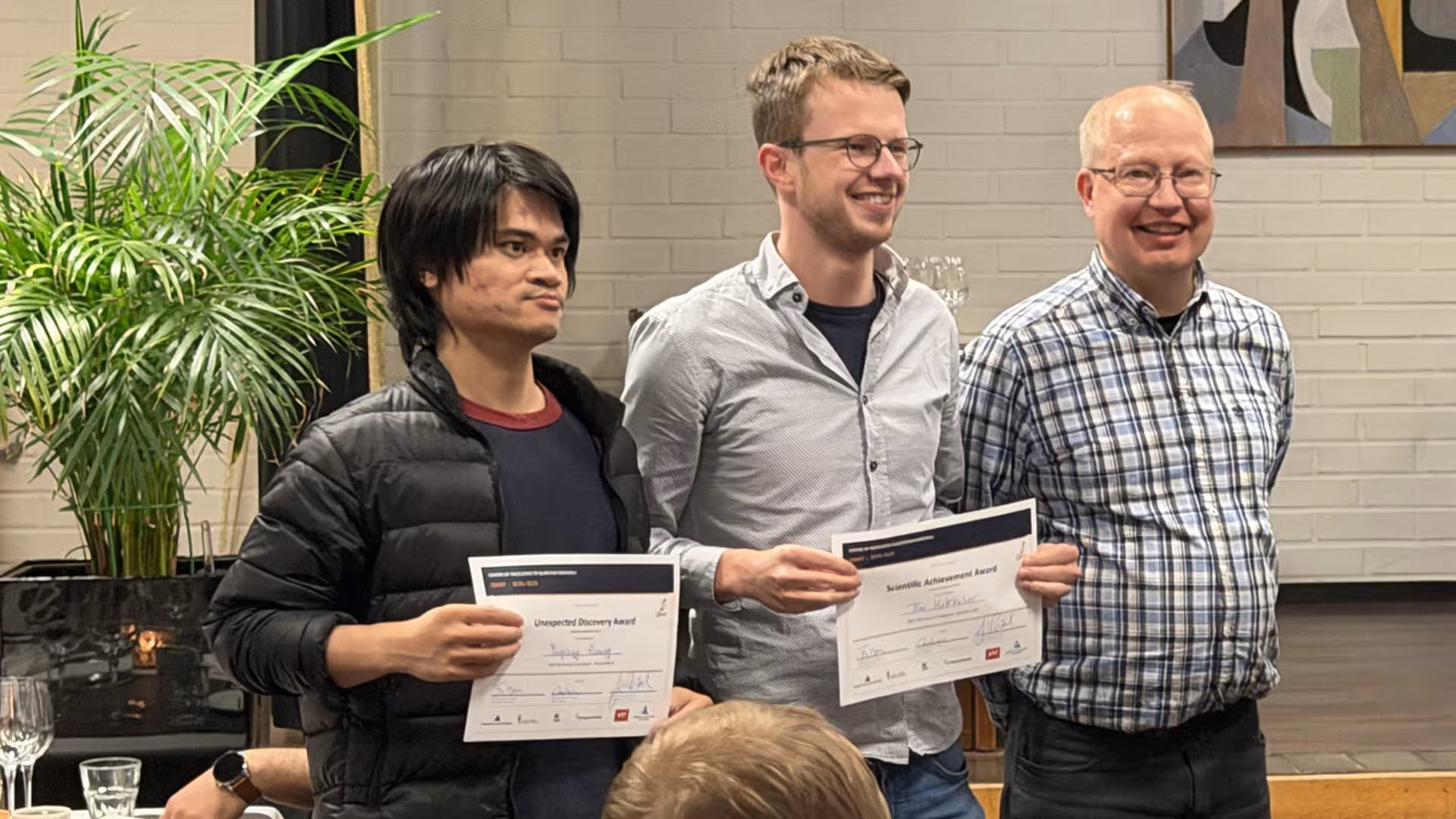
Each year, QMAT presents two awards to early-career researchers, either doctoral researchers or postdocs, from its participating groups: the Scientific Achievement Award and the Unexpected Discovery Award.
This year, the awards were presented at the QMAT Science Advisory Board meeting held on 3 and 4 November in Tuusula.
The Scientific Achievement Award recognises an outstanding research result. The Unexpected Discovery Award highlights a finding that took the research in a surprising new direction. Through these awards, the Centre wants to make visible that much of the research carried out in QMAT is driven by its young researchers, and to bring their results to a wider audience.
Scientific Achievement Award, to Tim Kokkeler (Condensed Matter Theory group at Jyväskylä). He's in the middle on the main image above.
Tim Kokkeler (together with Risto Ojajärvi) solved a long-standing question on how magnetic domain walls can be moved with supercurrents in magnet/superconductor hybrids (arXiv:2606.19078). This provides a recipe for realizing ultrafast magnetic memories operating at millikelvin temperatures, in analogy to Stuart Parkin’s racetrack memory idea. This superconducting version has orders of magnitude lower dissipation and heating than the normal-state racetrack memory.
The work also identifies experimentally directly accessible ways to identify the domain wall motion via localized voltage pulses. Kokkeler has also made important contributions to our understanding of altermagnetism, in particular for the spin splitter magnetoresistance (arXiv:2605.10747, PRB 114, 134516), interplay with superconductivity (PRB 113, 144516) and nonequilibrium effects
(together with experimentalists, Nature 659, 69 (2026)).
The Unexpected Discovery Award, to Youqiang Huang (Left in the main photo above).
Working with Prof. Jose Lado's group, Youqiang used nonlinear optical measurements to investigate chiral spin textures and their tunability. The collaboration brought together optical experiments and theoretical understanding of magnetism, revealing a connection between magnetic chirality and nonlinear optical responses.
The result offers a useful way to study magnetic textures through light and raises new questions about their optical signatures. The work was published in Nature Communications 17, 7576 (2026).
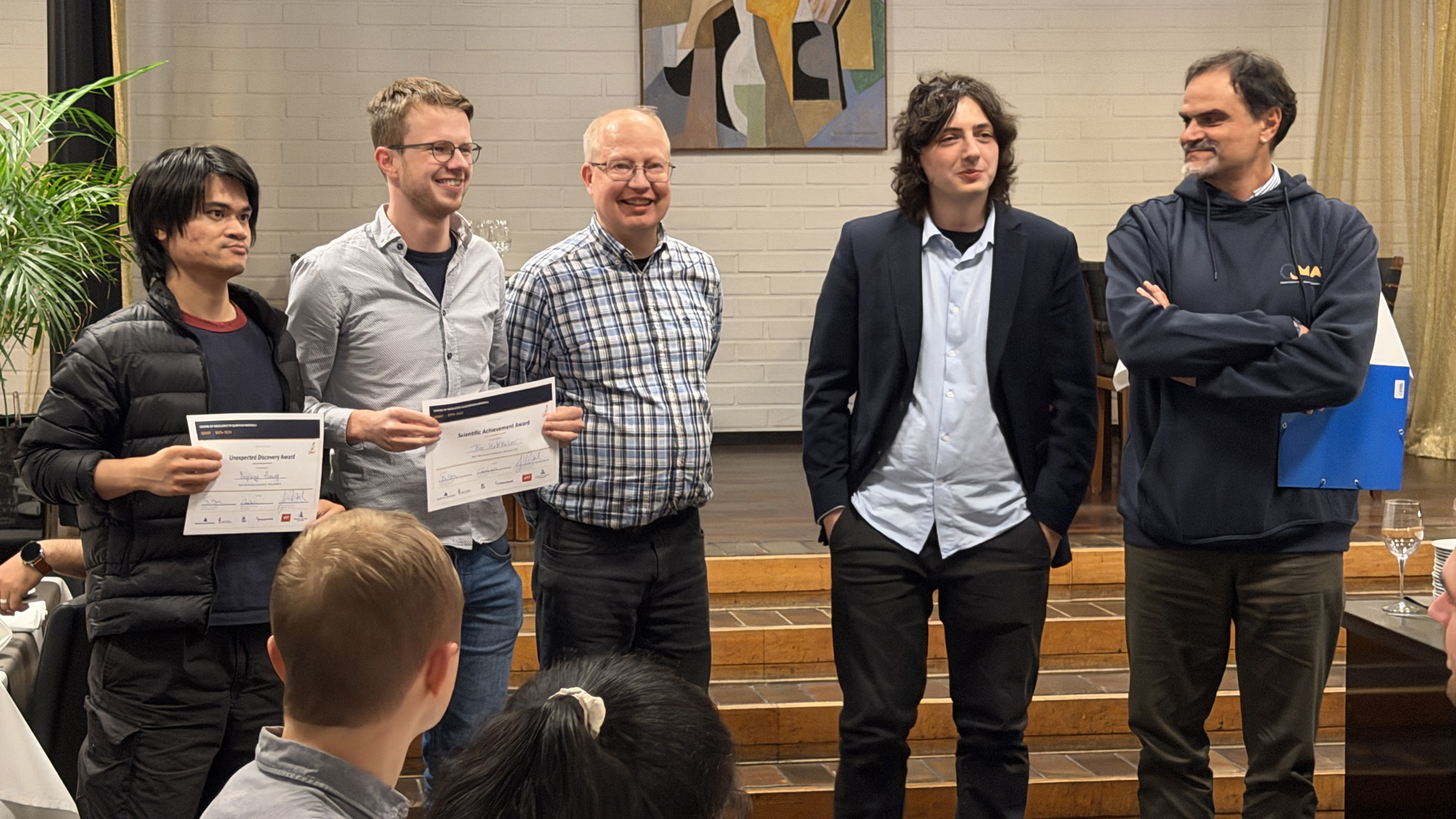
The awards were presented to Youqiang and Tim by Tero Heikkilä, José Lado and José Ignacio Pascual. The whole team congratulates Youqiang and Tim!