
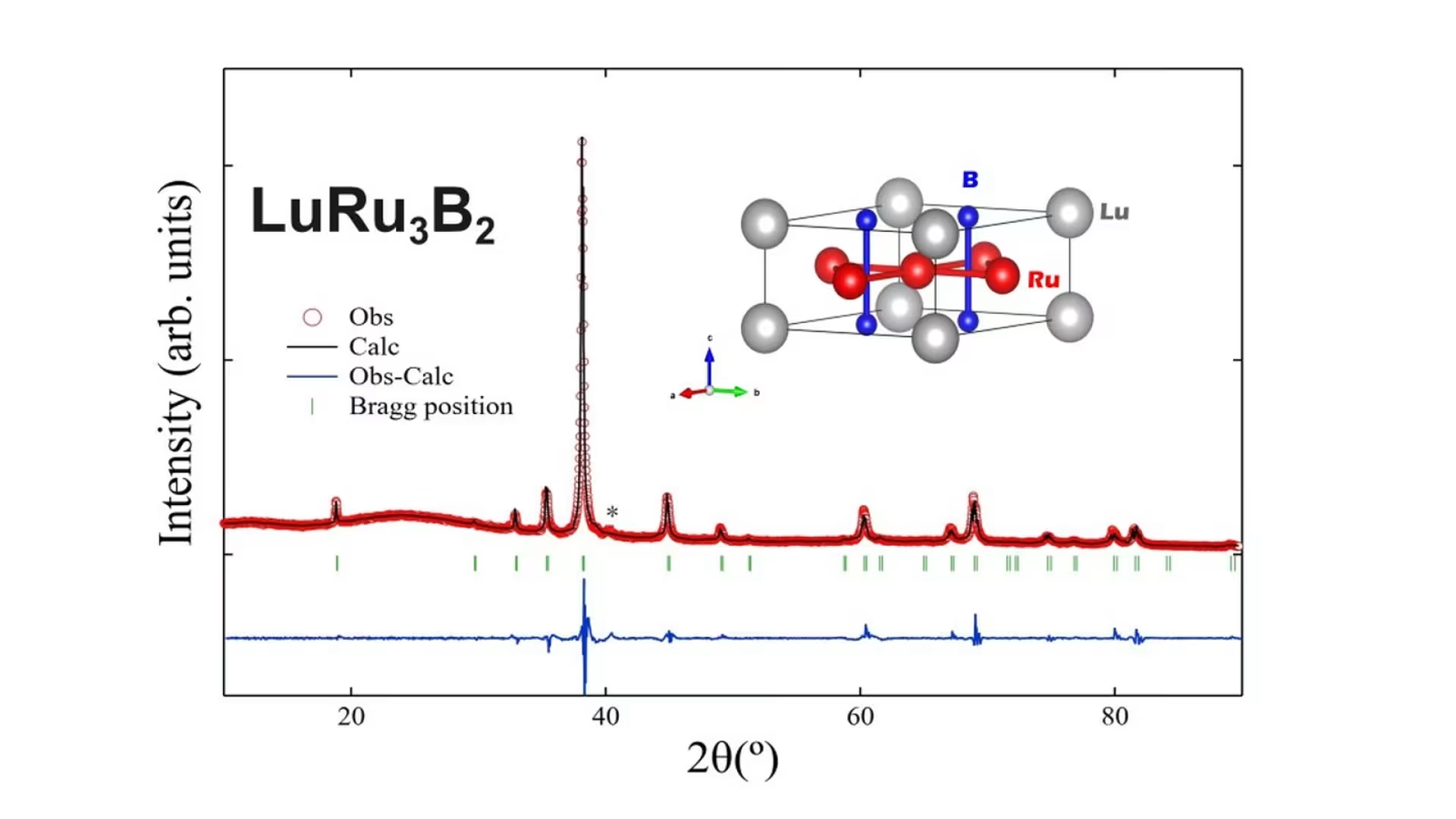
Machine-learning-accelerated screening combined with first-principles calculations predicted that two kagome-lattice compounds, YRu3B2 and LuRu3B2, should be superconductors. Experiments have now confirmed it: both show bulk superconductivity, at 0.81 K and 0.95 K respectively, with nearly 100% superconducting volume fractions.
Calculations explain why their transition temperatures are lower than in the related LaRu3Si2: a more dispersive quasi-flat band and stiffer phonons weaken the electron–phonon coupling, and conventional contributions to the superfluid weight outweigh quantum-geometric ones. From QMAT, Päivi Törmä's Quantum Dynamics group at Aalto University took part, with Junze Deng, Kaja Hiorth, Eeli Lamponen and Martin Gutierrez-Amigo. Partners included Rice University, Princeton University, Ruhr University Bochum and the Donostia International Physics Center.
Figure: Mustaf et al., Phys. Rev. Research (2026); image from arXiv:2512.16945, CC BY 4.0