
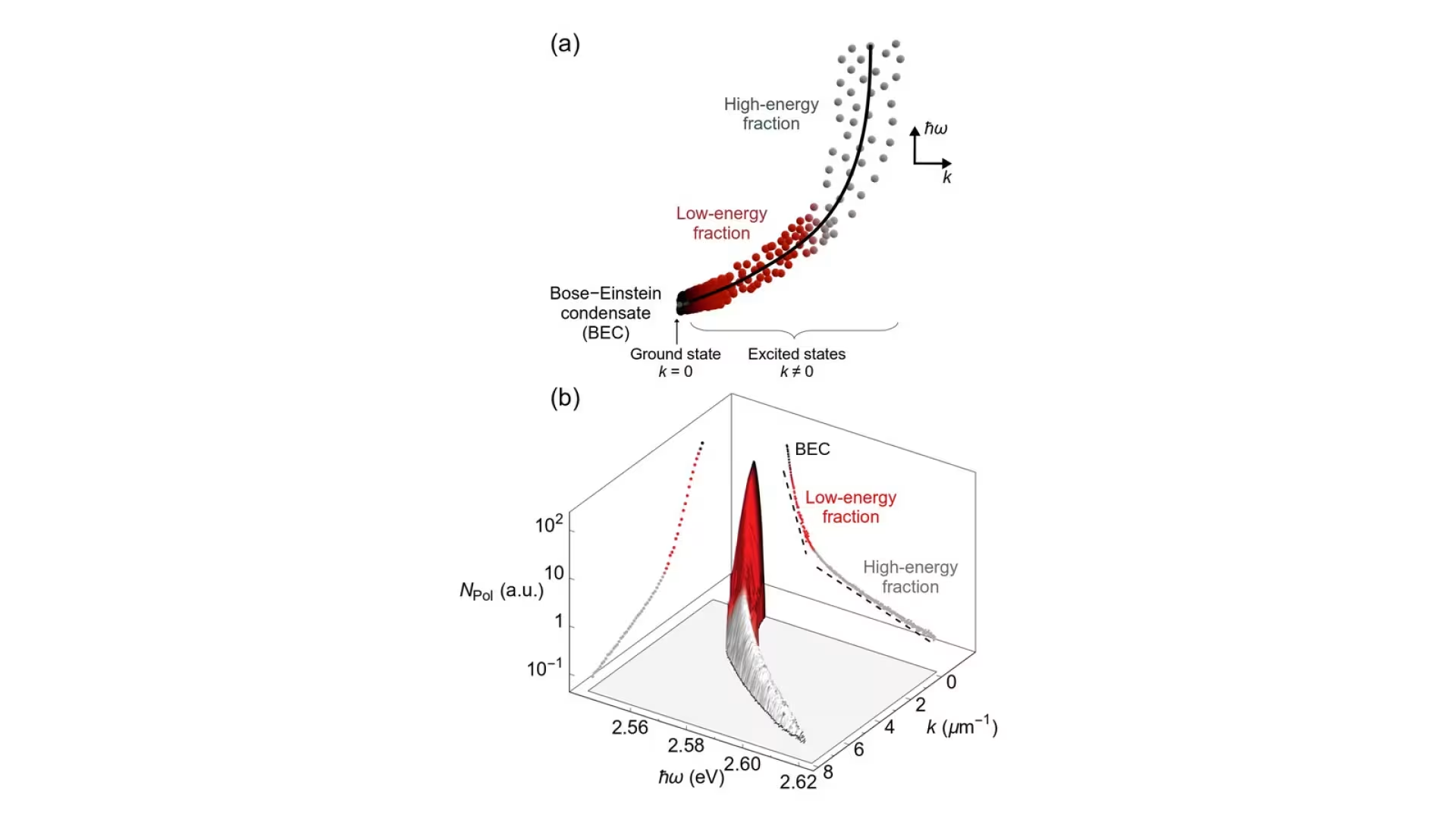
Exciton-polaritons, hybrids of light and matter, can form a Bose–Einstein condensate that is never fully in thermal equilibrium. Researchers have now observed stimulated cooling in such a condensate, from roughly room temperature down to 20 K. By resolving it in energy and momentum and using interferometry, they could distinguish the condensate from thermalised particles in excited states.
Those particles split into two fractions with different effective temperatures, and the results indicate that the gas temperature is set by the density-dependent chemical potential. The stimulated cooling also governs how the condensate becomes quantum coherent. The work comes from Aalto University's Macroscopic Quantum Optics Labs, with QMAT's Päivi Törmä and Evgeny Mamonov among the co-authors, and partners at IBM Research Zurich, the Paul Scherrer Institute, Tampere University and the University of Wuppertal.
The preprint has not yet been peer reviewed.
Figure: Ho et al., arXiv:2601.15080 (2026), CC BY 4.0