
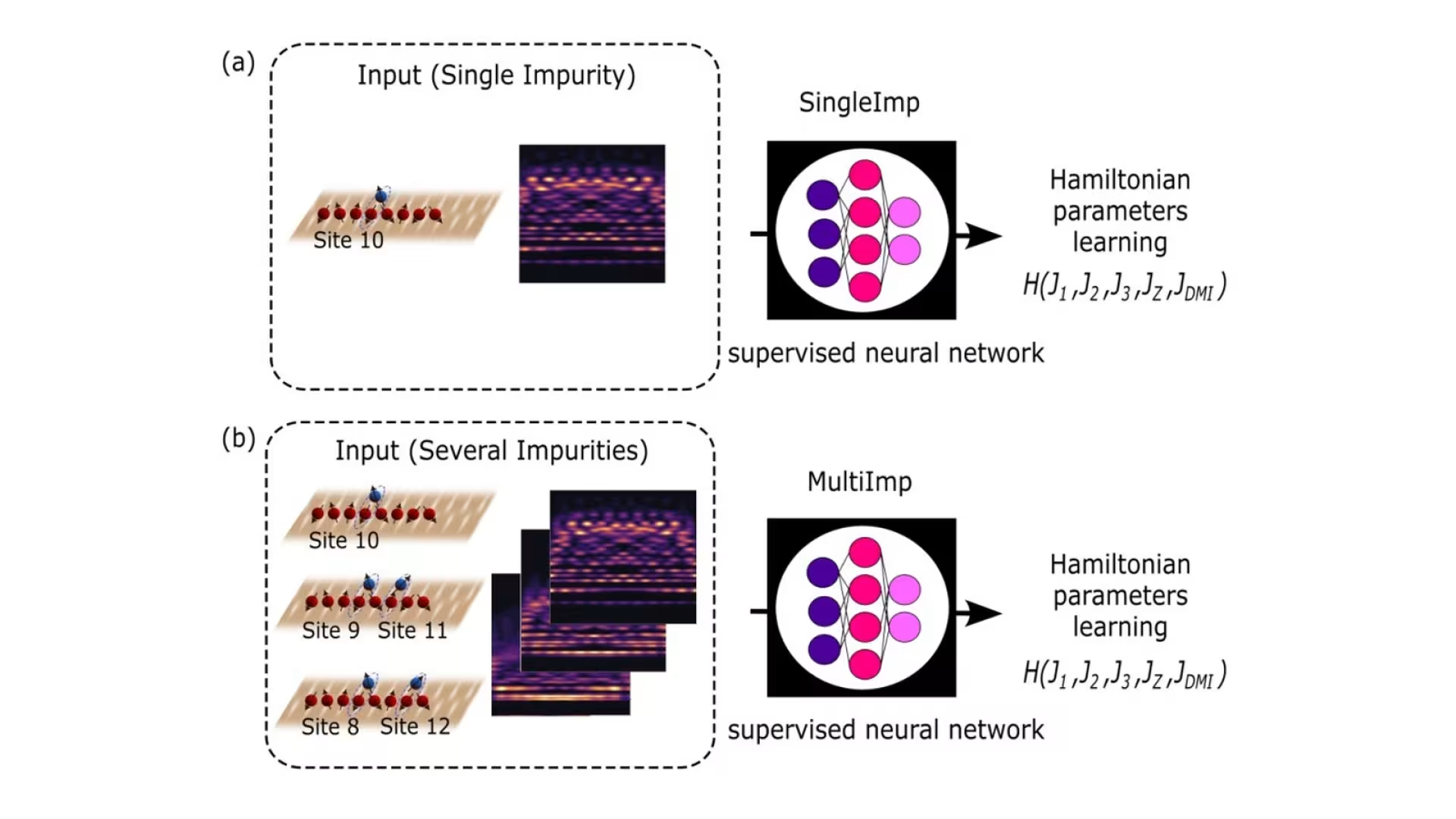
Engineered spin systems, from atoms on surfaces to nanographenes, can realise entangled quantum magnets from the bottom up, but working out exactly which Hamiltonian a given experiment realises is a major open challenge. Researchers in QMAT's Correlated Quantum Materials group at Aalto University show that machine learning can do this from scanning spectroscopy of spin excitations.
The key is to place quantum impurities next to the magnet and reconstruct the resulting spatially resolved many-body excitations. The algorithm then predicts long-range Heisenberg exchange, anisotropic exchange and Dzyaloshinskii–Moriya interactions, even in the presence of sizeable noise. The authors are Netta Karjalainen, Greta Lupi, Adolfo Fumega and Jose Lado, with Rouven Koch of Delft University of Technology.
Figure: Karjalainen et al., Phys. Rev. Research (2026); image from arXiv:2510.18613, CC BY 4.0