
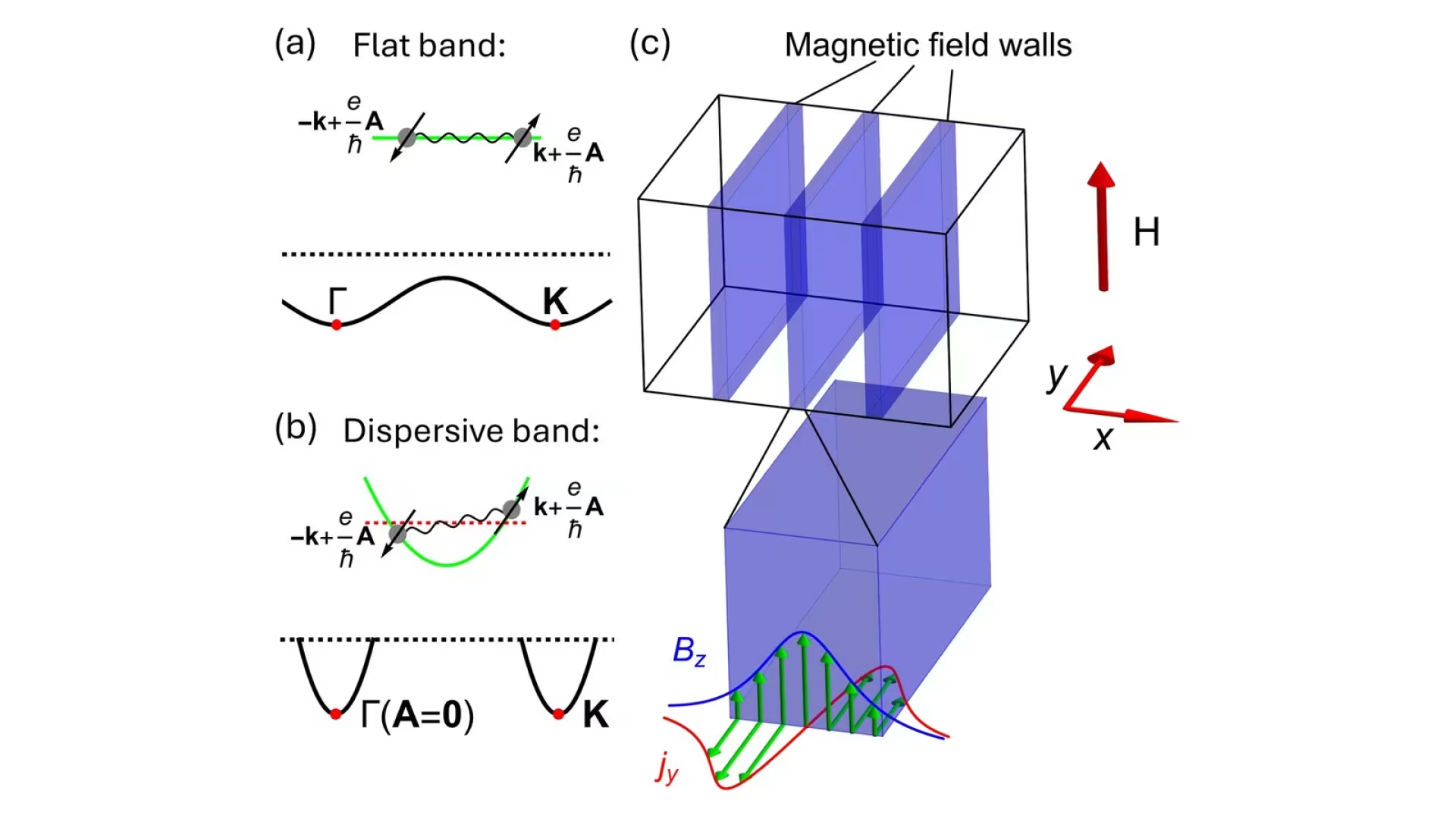
Superconductors respond to magnetic fields in characteristic ways, for example by forming Abrikosov vortices. Theorists from two QMAT groups predict that superconductors with flat electronic bands can instead host a stable phase containing walls of magnetic flux.
The phase arises because, in flat bands, forming condensates of any momentum costs no single-particle energy, which makes the superconducting free energy a periodic function of the vector potential at low temperatures. The authors study two types of soliton in the wall phase, which set the lower critical field and the high-field behaviour, and compare walls with vortices. The results suggest flat bands help superconductivity survive large magnetic fields. The authors are Guodong Jiang and Aaron Dunbrack with group leaders Tero Heikkilä (University of Jyväskylä) and Päivi Törmä (Aalto University).
The preprint has not yet been peer reviewed.
Figure: Jiang et al., arXiv:2606.06791 (2026), CC BY 4.0