
We report on the experimental observation of stimulated cooling in the non-equilibrium Bose–Einstein condensate (BEC) of weakly interacting exciton-polaritons from approximately room temperature down to 20K.
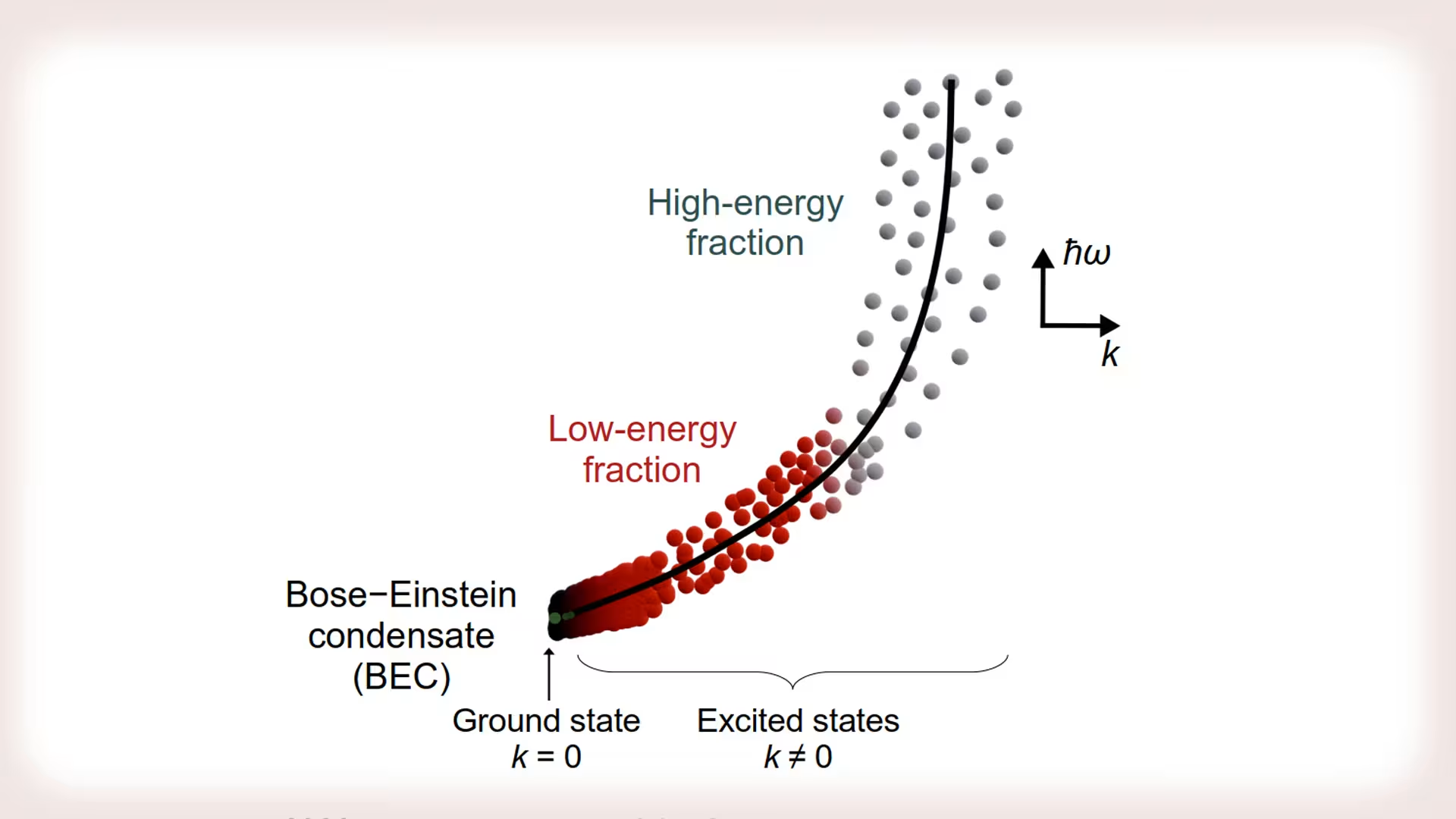
By resolving the condensate in energy–momentum space and performing interferometric measurements, we distinguish the condensate from thermalized particles yet occupying excited states macroscopically. In contrast to the analytical quantum theories of non-equilibrium BEC [Shishkov et al., Phys. Rev. Lett. 128, 065301 (2022)], we observe segmentation of the particle density along the excited states into two fractions both following Bose–Einstein distribution, albeit with different effective temperatures and chemical potentials.
Our results indicate that the temperature of the weakly interacting Bose gas is universally set by the density-dependent chemical potential, revealing a defining property of non-equilibrium BECs.
Finally, we demonstrate that the stimulated nature of the cooling process directly governs the emergence of quantum coherence of the condensate and shapes the dissipative properties of the excited states.