
Two-dimensional quantum materials without a repeating pattern are among the most difficult systems to compute.
Unlike ordinary crystals, which can be simplified using their periodic structure, quasicrystals and super-moiré materials must often be treated directly without taking advantage of these symmetries. That makes them computationally enormous, as even storing their mathematical description quickly overwhelms the largest supercomputing resources.
Now a team of QMAT researchers at Aalto University has shown how a quantum-inspired algorithm enables solving these exceptionally large non-periodic quantum materials. The team was lead by Assistant Professor Jose Lado (QMAT CoE vice-director), and included PhD researcher Tiago Antao, main author of the work, and QDOC PhD researcher Yitao Sun and RCF Research Fellow Adolfo Fumega.
Their work relies on translating the problem into the formulation that can be encoded in a quantum computer, and exploiting the exponential speed up provided by such a formulation.
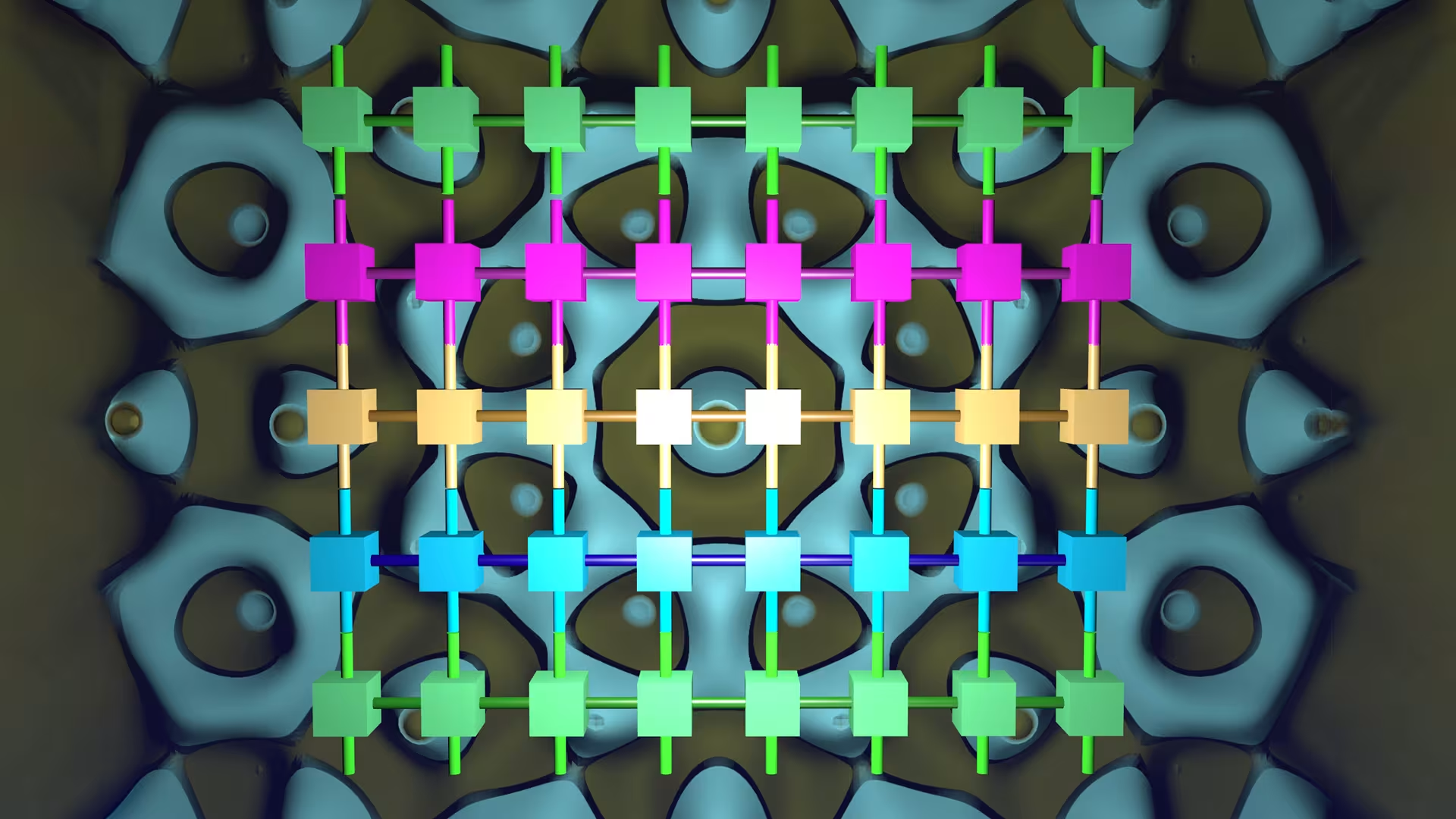
Quantum computers work in exponentially large computational spaces, and the researchers used a special algorithm that enables to encode those spaces, called tensor networks, to solve their large non-periodic quantum materials.
The materials the researchers focused on were topological quasicrystals. Quasicrystals are deterministic non-periodic structures, featuring emergent quantum states of matter not present in conventional crystals.
Topological quasicrystals feature on top of that unconventional excitations protected by the quantum mathematical description of the system, which can potentially enable to dissipationless electronics and new forms of quantum computing.
The Aalto team demonstrated their algorithm to compute a fundamental object to understand topological quasicrystals, the so called real-space topological invariant, that directly determines the appearance of unconventional excitations. Their method enabled reaching systems of hundreds of millions of sites, several orders of magnitude beyond conventional methodologies.
“Our algorithm shows how exceptionally large problems in quantum materials can be directly solved using exponential speed ups of an encoding as a quantum many-body problem", says Tiago Antao, Ph.D. researcher and the first author of the publication.
Topological quasicrystals feature excitations directly arising from topological properties, which in non-periodic material which are non-uniform across the material. Instead, different parts of the same system can host different local topological character, creating spatial mosaics that are invisible to simpler descriptions.
Being able to calculate those local topological invariants at realistic scales gives researchers a way to understand how exotic quantum behavior develops in systems that are too large and too structurally complex for existing standard approaches. These materials can be directly created experimentally by twisting two-dimensional materials, thus providing a direct experimental test for the newly developed quantum algorithm.
“The quantum-inspired algorithm we demonstrated enables us to solve super-moire quasicrystals several orders of magnitude above the capabilities of conventional methods, an instrumental step in order to design topological qubits with super-moire materials", states Lado, last author of the manuscript.
Their work brings together two focus directions of the Center of Excellence in Quantum Materials QMAT, moire materials and quantum algorithms.
Rather than solving the material with the conventional classical algorithms, the researchers reformulated the problem into the language used by quantum computers. This provides a strategy to reformulate generic exceptionally large problems into a form that directly exploits quantum speed up.
While their calculations were demonstrated using a method that approximately encodes the computational space accessed by quantum computers, their method can be adapted to run on real quantum computers, once they reach necessary scale and fidelity. In particular, the Finnish Quantum computing infrastructure can play a significant role for future demonstrations.
Furthermore, their results show that understanding and designing exotic quantum materials is of the first potential uses of quantum algorithms, and more broadly upcoming quantum computers.
These new quantum algorithms can enable the development of new quantum materials to build new paradigms of quantum computers, creating a two-way feedback loop between quantum materials and quantum computers.