
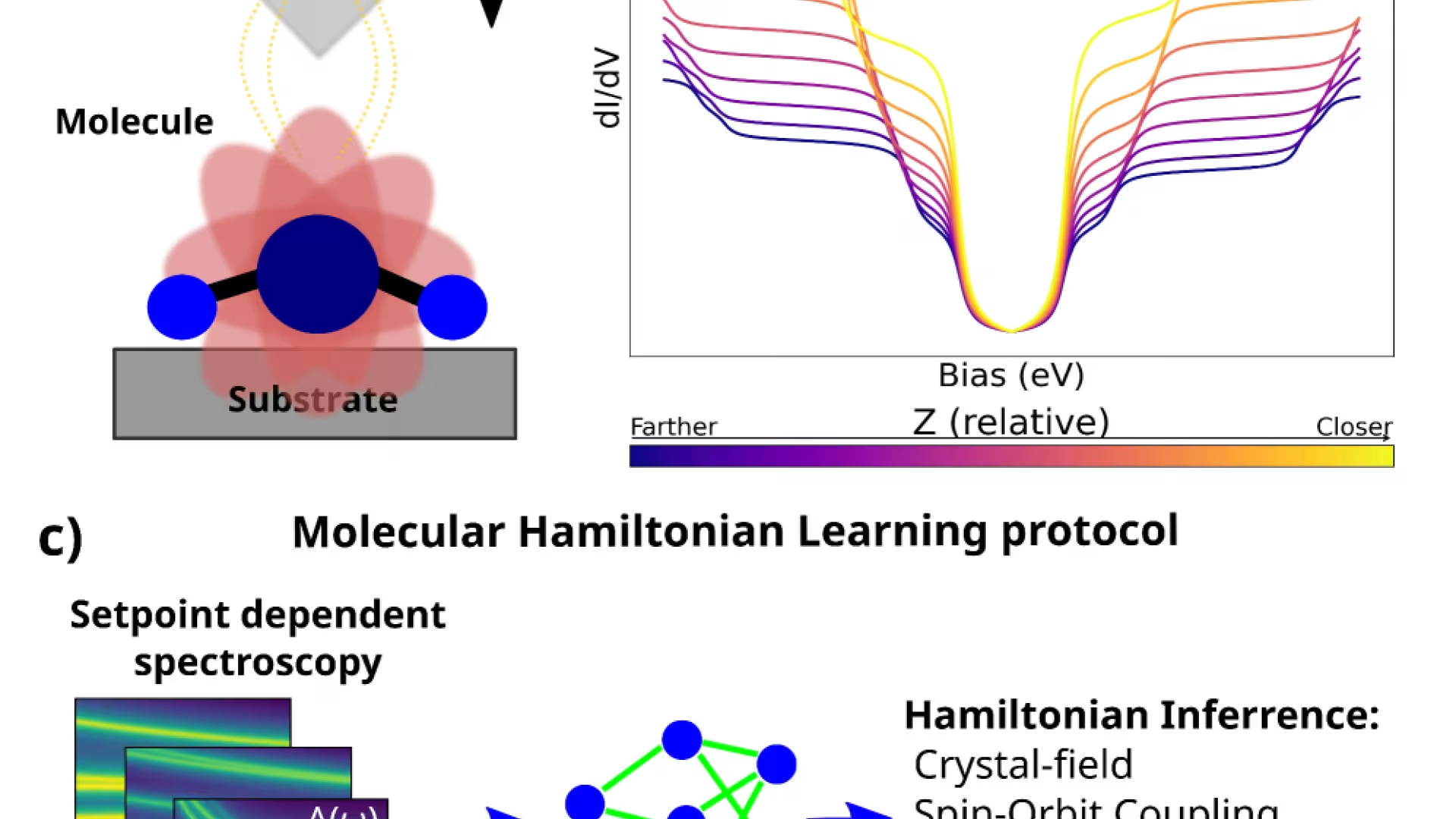
Molecular quantum magnets adsorbed on surfaces exhibit rich spin and orbital excitations that can be probed by scanning tunneling microscopy with inelastic electron tunneling spectroscopy (STM-IETS). However, the quantitative extraction of the underlying multiorbital Hamiltonian from experimental spectra remains a fundamental challenge.
Here, we introduce molecular Hamiltonian learning, a machine learning strategy that infers the microscopic Hamiltonian parameters of a single adsorbed molecule directly from the setpoint-dependence of STM-IETS data. The method leverages the systematic evolution of spectral features as the STM tip tunes the local electrostatic environment for different tip-sample distances. We demonstrate this approach on iron phthalocyanine on ferroelectric SnTe, training our algorithm on theory spectra from a realistic multiorbital model, including spin-orbit coupling, electrostatic interactions, local crystal field, and substrate effects.
The algorithm, trained solely on theoretical many-body simulations, allows reconstructing Hamiltonian parameters directly from experimental spectra. Our manuscript establishes a flexible and automated strategy for Hamiltonian reconstruction from STM-IETS, transforming setpoint-dependent spectroscopy into quantitative characterization of quantum materials at the atomic scale.