
Dear fellow QMAT members,
After submitting my doctoral thesis in August 2002, I started my postdoctoral position in the Low Temperature Laboratory at the then Helsinki University of Technology (now Aalto University) a few months before the thesis defense. It was already a Centre of Excellence and combined research in low-temperature physics and brain research.
The unit occupied a couple of floors in the physics building in Otaniemi: brain researchers were higher up and the physicists in the cellar. Space was tight. Coffee breaks were held in the corridors, with people sitting in rows, able to speak only to their two nearest neighbours. Two professors shared the same office, and one office had been constructed in a former cleaning closet.
I enjoyed the environment enormously. Every day I could talk with brilliant people who deeply cared about the topics they were studying. Later, I had the honour and pleasure of joining the unit’s next two Centres of Excellence as one of the principal investigators.
My PhD was in nanophysics – something I had chosen after a random encounter with my supervising professor Martti Salomaa during my undergraduate studies, prompted by a visiting researcher Gerd Schön, who was about to come to the laboratory the following summer.
But that is a story for another time.
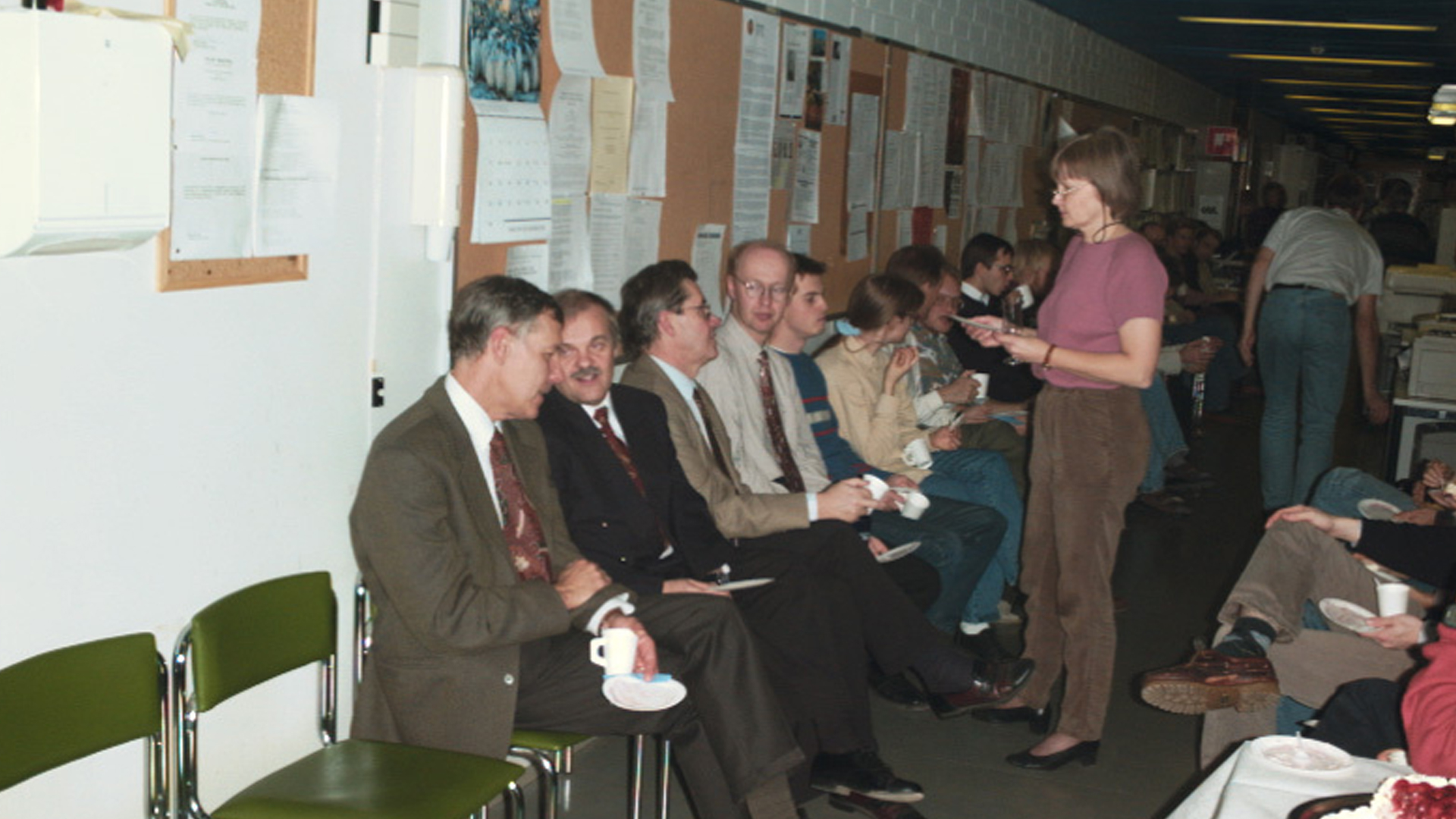
Festivities at the Low Temperature Laboratory in the 1990s. Photo: FINNA
Nanophysics happened to become a major topic also in the subsequent Centres of Excellence, so that random encounter turned out to be extremely influential in my later life. My physics career has not only benefitted from those Centres of Excellence. It has been defined by them.
Now we are starting a new Centre, QMAT, which will run for the next eight years. We have many plans, but as always in research, we are heading deep into the unknown. Because of the great team, I know that great things will happen. We will discover things that at first seem small but eventually grow into something that will shape – and hopefully improve – people’s lives. Some discoveries may seem big at first but lead to nothing.
The beauty of science is that we cannot know the importance of what we find beforehand. Often the relevance depends simply on whether there are the right people to push ideas forward. Hence we need to try to solve problems that seem relevant to us, and to convince others of their relevance as well.
From a broader perspective, history shows that science is one of the strongest drivers of progress in the world. Even the work of the brightest individuals leads to little change without others. That is why we need research consortia such as QMAT.
So, I hope you all can use the Centre of Excellence as a means to learn and discover, to advance your career, and to change the world. Aim high: with the help of your colleagues, you can truly make a difference.
But above all, remember to enjoy the ride!
Tero